
Aerodynamics of a Building
Aerodynamics of a Building
ARTICLES
Wiratama
12/2/20253 min read
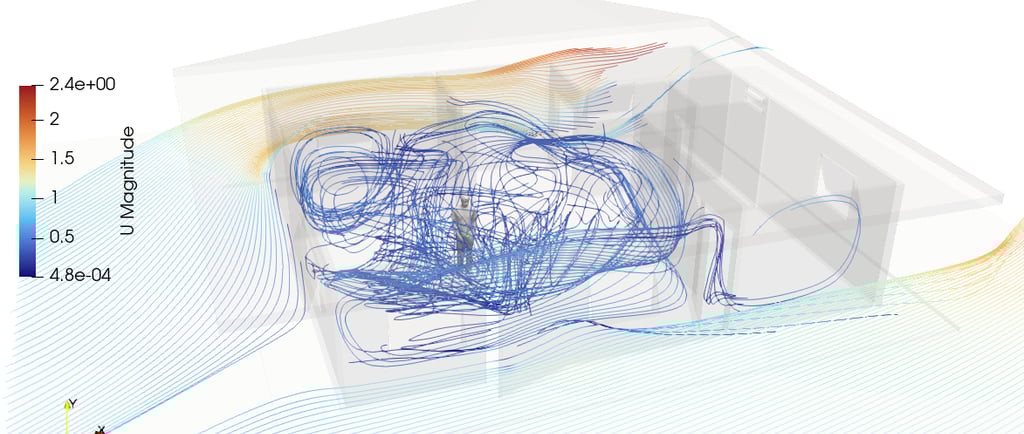
Wind patterns and fluctuating air streams interact continuously with the built environment, shaping everything from pedestrian comfort to façade loading to the internal ventilation performance of a building. These phenomena form the core of building aerodynamics. When a structure is introduced into a wind field, it alters pressure zones, redirects flow, induces turbulence, and reshapes the surrounding microclimate. Understanding these effects is fundamental to delivering safe, functional, and comfortable urban spaces.
One of the most critical aspects in this discipline is the evaluation of wind loads acting on building façades and structural elements. Engineers study how wind pressures distribute over surfaces, how aerodynamic shapes redirect flow, and how local conditions around streets, plazas, and entrances change the pedestrian experience. At the ground level, comfort can rapidly deteriorate when wind accelerates around corners, funnels through passages, or recirculates in enclosed spaces. Designers therefore assess aerodynamic factors that influence outdoor usability, adjacent building interaction, natural ventilation potential, and internal thermal comfort.
Economic considerations also play a substantial role. When outdoor spaces feel uncomfortable due to persistent wind, business activity suffers. Pedestrian footfall declines, café seating empties, and outdoor amenities may lose their intended value. Even modest wind speeds can deter casual activities such as sitting on a bench or browsing store windows. Beyond commercial impacts, unchecked aerodynamic issues can diminish property appeal, reduce balcony or terrace usability, and complicate construction efforts. Ensuring that wind comfort promotes rather than hinders urban life is therefore tied to economic viability as much as it is to engineering performance.
Urban landscape characteristics influence wind behavior as strongly as building geometry. Complex terrain, steep slopes, and irregular city grids create wind accelerations, localized vortices, and pressure variations that cannot be predicted reliably through simplified assumptions. Computational fluid dynamics (CFD) simulations help engineers visualize and study these effects, revealing flow separations, stagnation points, high-velocity channels, and recirculation zones that emerge around buildings. By reviewing these aerodynamic patterns, designers can adjust massing, façade treatments, or spatial layouts to achieve calmer pedestrian conditions and reduce aerodynamic discomfort.
Wind loads themselves include both static and dynamic components. Static forces remain constant over time, while dynamic forces vary in magnitude and direction. Wind belongs to this second category, and its variability makes aerodynamic analysis essential. Buildings can experience vortex shedding, oscillations, or fluctuating crosswind forces that approach structural resonance, making the prediction of wind load effects a core safety requirement. Simulation-based analysis allows engineers to evaluate façade pressure distributions, determine force fluctuations, and assess structural response long before construction begins.
Building ventilation performance is also tightly coupled to aerodynamics. When form, orientation, and opening placement allow outdoor air to move naturally through interior spaces, passive ventilation can reduce energy usage, increase comfort, and maintain indoor freshness. In dense urban environments or areas with poor external air quality, natural ventilation may become impractical, requiring mechanical systems to sustain adequate air exchange. Aerodynamic evaluation helps determine when passive strategies are feasible and where mechanical solutions are necessary.
CFD models offer insight into both indoor and outdoor airflow, helping designers test different configurations, compare alternatives, and refine concepts based on measurable flow characteristics. By studying velocity fields, pressure behavior, pollutant transport, and air exchange rates, engineers can identify whether wind conditions support natural ventilation, whether pedestrian comfort thresholds are met, and whether façade features should be reshaped to reduce aerodynamic intensity. These simulations take much of the guesswork out of aerodynamics and support design decisions with quantifiable, visualized evidence.
As wind has a direct influence on pedestrian comfort, building usability, construction safety, and architectural outcomes, aerodynamic assessment has become a fundamental step in modern design. Simulation-based aerodynamic studies allow project teams to validate performance, identify design risks, and develop mitigation strategies that improve urban quality and user experience. This approach bridges the gap between architectural ambition and environmental reality, supporting safer, more livable city spaces.
Study Building Aerodynamics with tensorHVAC-Pro
For engineers seeking to evaluate wind loads, pedestrian comfort, natural ventilation potential, or aerodynamic effects on the built environment, tensorHVAC-Pro provides advanced CFD-based tools tailored to building aerodynamics. With high-fidelity solvers, automated meshing, and dedicated comfort-analysis features, tensorHVAC-Pro helps designers visualize airflow, resolve wind pressures, refine massing, and optimize outdoor microclimates—ensuring that aerodynamic performance becomes an asset rather than a challenge in the design process.
tensorHVAC-Pro is a dedicated HVAC flow and thermal simulation software, Intuitive and easy to use, designed for HVAC engineers - not CFD expert. Learn more..
Read more articles..