
Benefits of Flow and Thermal simulation software in HVAC Design
By integrating digital tools into the design and analysis process, engineers can streamline workflows, reduce costs, and deliver higher performance systems.
ARTICLES
Wiratama
10/28/20252 min read
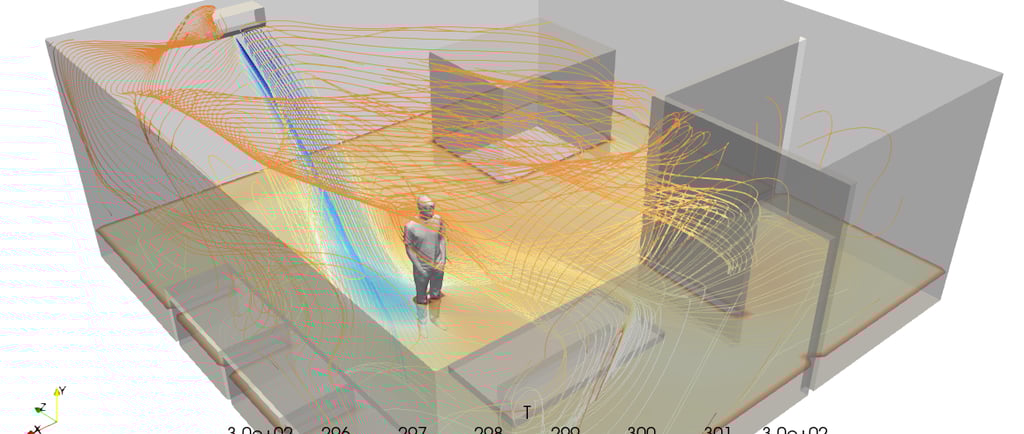
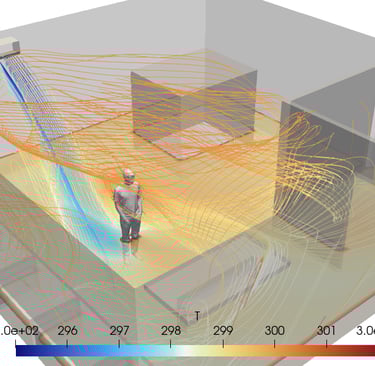
In modern building design, HVAC engineering software plays a vital role in creating efficient, reliable, and sustainable indoor environments. By integrating digital tools into the design and analysis process, engineers can streamline workflows, reduce costs, and deliver higher performance systems. From concept to commissioning, HVAC software has become an essential asset for professionals seeking precision and productivity.
1. Efficiency
HVAC engineering software significantly increases the speed and accuracy of system design. Traditional manual calculations are replaced with automated tools that handle load analysis, duct sizing, heat transfer, and pressure drop calculations instantly. This not only saves time but also reduces the potential for human error. Simulation-based tools like tensorHVAC-Pro further enhance efficiency by allowing engineers to evaluate airflow and temperature distributions virtually — all within a user-friendly interface designed for HVAC professionals rather than CFD experts.
2. Optimization
Optimization is at the heart of smart HVAC design. With simulation-driven tools, engineers can test multiple design scenarios, adjusting flow rates, diffuser positions, or insulation levels to find the most energy-efficient configuration. By visualizing system performance before installation, designers can minimize pressure losses, balance air distribution, and achieve ideal comfort levels. Software like tensorHVAC-Pro makes this process intuitive, enabling continuous fine-tuning that leads to better comfort, lower energy use, and improved system reliability.
3. Cost Estimation
Accurate cost forecasting is crucial for project success. HVAC software integrates equipment databases, installation parameters, and operational cost estimations into the design process, giving engineers a complete financial overview. This ensures that budgets remain realistic from the planning stage to execution. By simulating performance early, engineers can identify overdesigns or inefficiencies that would otherwise increase costs. The result is a more cost-effective and predictable HVAC project lifecycle.
4. Compliance
Building regulations and energy standards, such as ASHRAE, ISO, and local energy codes, play a major role in HVAC design. Engineering software incorporates these standards directly into the workflow, automatically checking compliance during the design phase. This helps avoid costly redesigns or code violations later in the project. With built-in compliance checks, engineers can focus more on performance and less on paperwork, ensuring safe, lawful, and efficient HVAC systems.
5. Collaboration
Modern HVAC projects involve multiple stakeholders — engineers, architects, contractors, and clients — all working with the same system data. Software platforms enable seamless data sharing, model coordination, and version control, ensuring everyone stays aligned. Cloud-based tools and BIM integration (Building Information Modeling) further improve collaboration, making it easier to coordinate design changes in real time and reduce communication errors during construction.
6. Visualization
Visualization transforms how HVAC systems are planned and understood. Tools like Autodesk Revit, coupled with simulation software such as tensorHVAC-Pro, allow engineers to view 3D models of air distribution, temperature maps, and flow behavior within the building. This virtual environment helps identify potential design conflicts — like airflow stagnation, thermal imbalance, or duct interference — before implementation. Visualization not only improves technical accuracy but also helps communicate complex ideas clearly to non-engineering stakeholders.
tensorHVAC-Pro is a dedicated flow and thermal HVAC simulation software, easy to use and intuitive designed for HVAC engineers - not CFD expert. Learn more..
Read more articles..