
Data Center HVAC Cooling Design
Data Center HVAC Cooling Design
ARTICLES
Wiratama
1/5/20264 min read

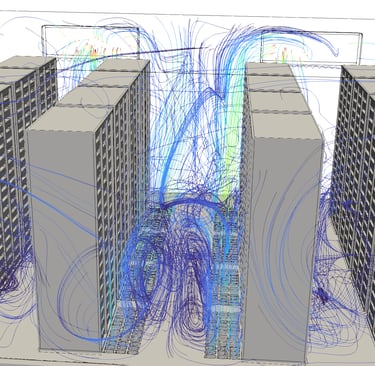
Importance of Cooling and Heat Dissipation in Data Centers
Cooling and heat dissipation are critical considerations in both the design and operation of data centers. In practice, many facilities fail to meet client expectations for reliability and availability—not due to power or network issues, but because cooling systems are underestimated during the design process.
Too often, significant attention is given to power and network redundancy, while air-conditioning systems are treated as secondary. However, a data center is only as reliable as its weakest supporting system. Even a short interruption in cooling can be just as damaging as a power outage, potentially leading to equipment failure, data loss, and extended downtime.
This section outlines the key design factors that must be addressed when planning data center cooling systems, including:
Heat gains
Temperature and humidity requirements
Ventilation rates
Airflow and air quality
Cooling loads
HVAC equipment selection
Heat Gains in Data Centers
Every piece of IT hardware in a data center requires a continuous supply of cooling air and effective removal of heated exhaust air. The primary source of heat gain is the IT equipment itself. As a rule of thumb, 1 kW of electrical power consumed by a server results in approximately 1 kW of heat that must be removed.
Modern data centers may contain hundreds of racks, each with up to 42 servers, resulting in extremely high heat densities per unit floor area. In addition to IT equipment, other contributors to heat gain include:
Solar heat gains through walls, roofs, and windows
Ventilation air loads due to pressurization and occupancy
Auxiliary systems such as lighting, UPS units, switchgear, and power cables
Cumulatively, heat densities can reach 300 W/ft² of floor area, all of which must be accounted for in the cooling load calculation.

Temperature and Humidity Requirements
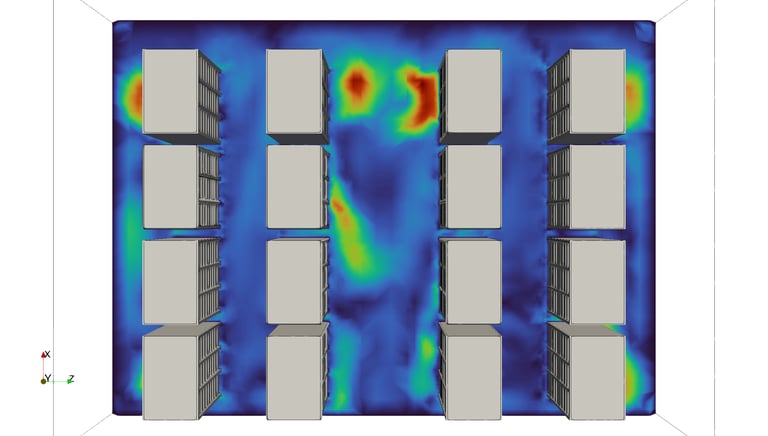
Recommended environmental conditions for data centers are defined in ASHRAE environmental guidelines, which specify operating ranges based on supply air temperature and dew point rather than traditional comfort metrics.
Recommended conditions include:
Dry-bulb temperature: 64.4°F to 80.6°F
Dew point temperature: 41.9°F to 59°F
Unlike comfort spaces, data centers rely on cool supply air delivered directly to server inlets. The use of dew point (or absolute humidity) provides a more reliable measure of moisture control across both cold supply air and warm exhaust air streams.
Effects of Temperature on IT Equipment
Excessive temperatures can cause electronic components to malfunction or fail due to thermal expansion, material degradation, or overheating. In addition, rapid temperature increases—known as the temperature rate-of-rise—can be especially damaging.
A typical acceptable rate of temperature rise is approximately 0.5°C per minute, which places strict requirements on HVAC system response time, particularly during power transitions or system restarts.
Effects of Humidity on Data Center Hardware
Humidity control is equally critical. Excessively high humidity can cause condensation on components, leading to electrical shorts. Conversely, air that is too dry increases the risk of electrostatic discharge (ESD), which can damage sensitive electronics and pose fire hazards.
ESD risk increases significantly when relative humidity falls below 35%.
Relative Humidity vs. Absolute Humidity
While comfort systems often specify relative humidity (RH), absolute humidity or dew point is preferred for data centers.
Relative humidity varies with temperature
Absolute humidity represents the actual moisture content of the air
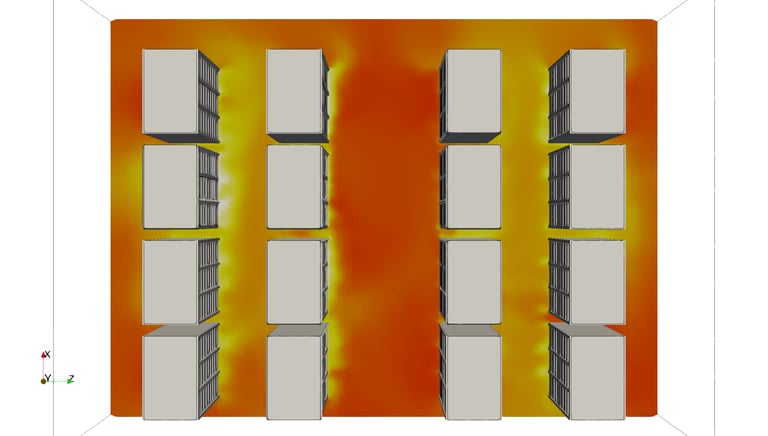
Since server exhaust air is warmer than supply air but contains the same moisture content, absolute humidity provides a consistent and more reliable control metric. Recommended absolute humidity levels correspond to a dew point range of 41.9°F to 59°F, allowing consistent monitoring at server inlets.
Ventilation Air Requirements
Ventilation air is required for:
Space pressurization
Occupant comfort and indoor air quality
Outdoor air quantities should comply with standard ventilation requirements (typically 15 CFM per person). In most data centers, however, ventilation air supplied for pressurization exceeds the minimum required for occupants.
Airflow Rates and Air Quality
High heat densities require extremely large airflow rates. For example:
A heat load of 300 W/ft² requires approximately 35–40 CFM per ft²
A 10,000 ft² data center may require 350,000–400,000 CFM of circulating air
Such airflow levels demand high-capacity fans and significant energy input, making airflow optimization essential.
Pressurization
To minimize dust infiltration, data centers should be positively pressurized relative to surrounding spaces. A typical design target is 0.02 inches of water gauge (±0.01). Achieving this requires:
Airtight construction
Controlled supply, return, and exhaust airflow
Minimization of leakage through doors, penetrations, and structural gaps
Filtration Requirements
All air entering the data center should be filtered to a minimum of MERV 10, providing:
At least 50% dust spot efficiency
Greater than 95% arrestance
In harsh environments (corrosive gases, salt air, heavy dust), enhanced chemical or electrostatic filtration may be required. These requirements should be identified early, as retrofitting filtration can necessitate fan upgrades.
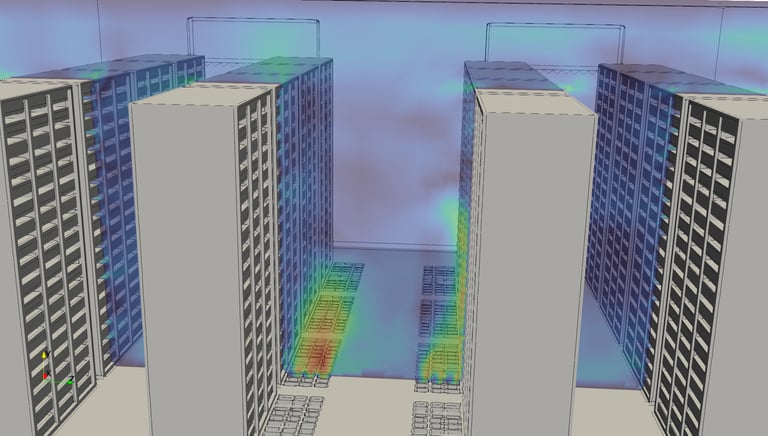
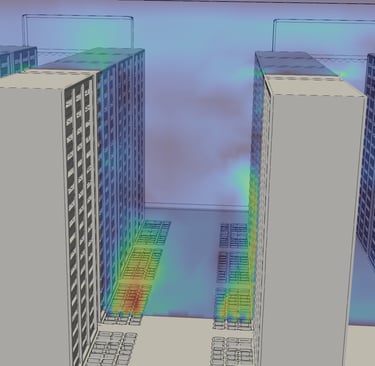
Cooling Load and Equipment Selection
Cooling capacity is commonly expressed in:
BTU/hr
Watts
Tons of refrigeration (1 ton = 12,000 BTU/hr ≈ 3.52 kW)
Total cooling load includes:
Internal heat gains (IT equipment, lighting, people, power systems)
Building envelope loads
Ventilation and infiltration loads
Sensible vs. Latent Cooling
Data centers primarily generate sensible heat (temperature increase without moisture). Therefore, cooling systems must have a high sensible heat ratio (SHR):
Comfort systems: SHR ≈ 0.60–0.70
Data center systems: SHR ≈ 0.85–0.95
Precision Cooling Equipment
Data centers use precision air-conditioning systems, commonly known as CRAC units, designed to:
Deliver near-100% sensible cooling
Maintain temperature within ±1°F
Control humidity within ±3% RH
Provide high airflow rates (500–600 CFM per ton, compared to ~400 CFM per ton for comfort systems)
These characteristics make precision cooling systems essential for maintaining reliability in high-density data center environments.
tensorHVAC-Pro is a dedicated HVAC flow and thermal simulation software, Intuitive and easy to use, designed for HVAC engineers - not CFD expert. Learn more..
Read more articles..