
Designing Data Center Cooling Systems Under ASHRAE 90.4
Designing Data Center Cooling Systems Under ASHRAE 90.4
ARTICLES
Wiratama
12/3/20252 min read
Data centers are among the most energy-intensive facilities in modern infrastructure. Operating 24/7, they support critical digital services for business, science, and technology worldwide. As computing demand grows, so does the urgency to design cooling systems that are not only reliable, but also highly energy-efficient.
Heating, Ventilation, and Air Conditioning (HVAC) systems play a dominant role in this challenge. It is estimated that data centers consume around 3% of global electricity, with annual growth exceeding 4%. Studies referenced by ASHRAE show that cooling infrastructure alone can account for up to 50% of total data center energy use, making it the single largest energy consumer in these facilities.
This reality has shifted design priorities. Today, energy efficiency of cooling systems often outweighs traditional concerns such as redundancy and security during the early design phase.
Which HVAC Standards Should Data Centers Follow?
For many years, evaluating data center energy efficiency was difficult due to inconsistent benchmarks. The introduction of Power Usage Effectiveness (PUE) helped quantify operational efficiency, but PUE is a performance metric—not a design standard. It does not directly guide engineers on how to design HVAC systems that achieve compliance from day one.
To address this gap, ASHRAE developed a dedicated standard for data centers.
Understanding ASHRAE 90.4: A Design-Focused Energy Standard
Published in 2016, ASHRAE 90.4 establishes minimum energy efficiency requirements specifically for data centers, covering:
Design and construction
Operation and maintenance planning
Use of on-site and off-site renewable energy
Unlike traditional building standards, ASHRAE 90.4 recognizes that data centers have unique thermal loads, airflow patterns, and operational risks. Instead of relying on a single high-level metric, the standard evaluates efficiency based on representative system components, losses, and climate-zone-dependent limits.
For HVAC engineers, this means efficiency must be designed, not assumed.
How CFD Supports Compliance with ASHRAE 90.4
Cooling performance in a data center is highly sensitive to layout and airflow management. Small design decisions—rack arrangement, ceiling height, containment strategy, or supply air distribution—can significantly impact efficiency and hotspot formation.
This is where Computational Fluid Dynamics (CFD) becomes a powerful design tool.
CFD allows engineers to:
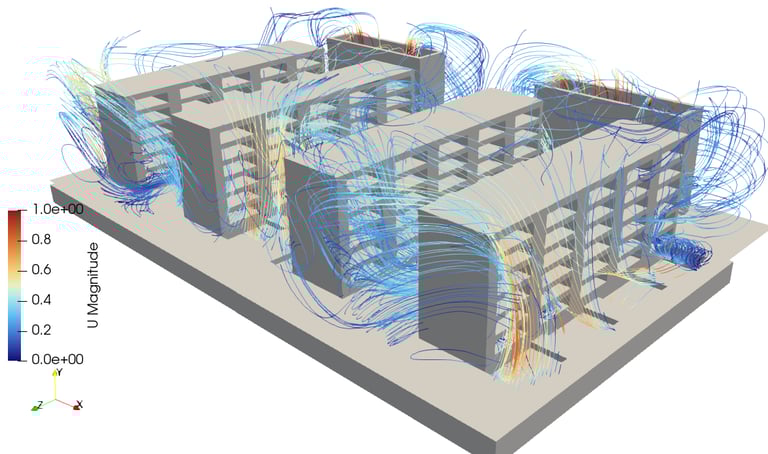
Visualize airflow paths and temperature distribution
Identify hotspots and recirculation zones early
Compare multiple design strategies virtually
Reduce over-design and unnecessary cooling capacity
Modern CFD-driven workflows, such as those implemented in tensorHVAC-Pro, enable HVAC teams to evaluate design compliance with ASHRAE 90.4 before construction begins, reducing both technical risk and operational cost.
Design Strategies to Reduce Data Center Cooling Energy
Improving cooling efficiency typically involves a combination of architectural, mechanical, and operational decisions, including:
1. Climate-Aware Facility Planning
Site location and ambient conditions directly influence cooling load and free-cooling potential.
2. Infrastructure Topology Decisions
IT density, rack arrangement, and tier requirements all affect airflow demand.
3. Optimized Cooling System Configurations
Common strategies include:
CRAC / CRAH units for targeted air delivery
Hot aisle / cold aisle layouts to minimize air mixing
Hot or cold aisle containment to prevent recirculation
Liquid cooling for high-density racks
Free cooling / green cooling using ambient air or water sources
Finding the right combination of these approaches is complex—and highly design-specific.
Designing for Performance, Not Just Compliance
A single large data center can consume as much electricity as tens of thousands of homes. As energy prices rise and sustainability targets tighten, cooling efficiency is no longer optional—it is a core design requirement.
ASHRAE 90.4 provides the framework, but engineering insight and simulation-driven design are what make compliance achievable in real projects.
Tools like tensorHVAC-Pro support this process by combining HVAC engineering principles with CFD-based analysis, helping designers make confident, data-backed decisions early in the project lifecycle—when changes are least costly and most effective.
tensorHVAC-Pro is a dedicated HVAC flow and thermal simulation software, Intuitive and easy to use, designed for HVAC engineers - not CFD expert. Learn more..
Read more articles..