
Designing Efficient Ventilation Flow in Car Parks
Car park ventilation is a critical component in building engineering, ensuring that enclosed or semi-enclosed parking structures maintain safe air quality, acceptable temperature levels, and compliance with safety standards.
CASE-STUDIESARTICLES
Wiratama
12/2/20254 min read
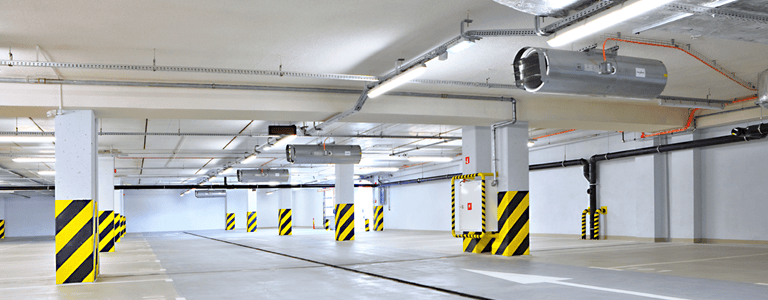
Car park ventilation is a critical component in building engineering, ensuring that enclosed or semi-enclosed parking structures maintain safe air quality, acceptable temperature levels, and compliance with safety standards. Whether an underground facility with limited natural air access or an enclosed multi-storey parking building, the main purpose of designing air flow is to manage contaminant accumulation, prevent hazardous smoke buildup, and reduce energy consumption. Modern parking facilities face the continual challenge of carbon monoxide and nitrogen oxide emissions from vehicles, as well as the need to manage smoke stratification during fire events. An effective ventilation system must provide sufficient fresh air circulation, guide air to extraction zones, and operate intelligently to avoid excessive energy usage.
image: www.woodsairmovement.com
At the core of a successful design is a clear understanding of airflow objectives. A well-planned ventilation system must dilute and extract harmful gases, maintain healthy breathing environments, regulate heat accumulation, and transition rapidly into smoke-control mode during emergencies. Contaminant control typically relies on sensor-based monitoring that activates fans only when pollutant concentrations exceed certain limits. Many regional building codes define acceptable pollutant thresholds and required air change rates, which engineers must incorporate early in the design stage. Beyond normal daily operation, the same infrastructure must also provide efficient smoke movement and extraction during a fire scenario, ensuring safe evacuation pathways and clear air zones protected from smoke backflow.
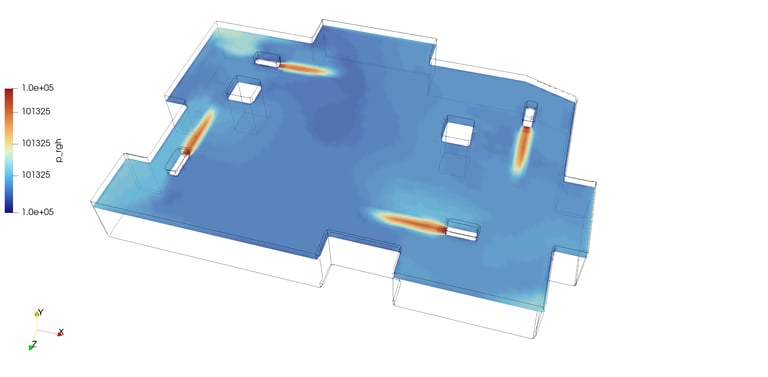
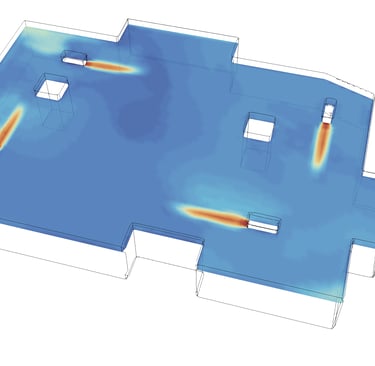
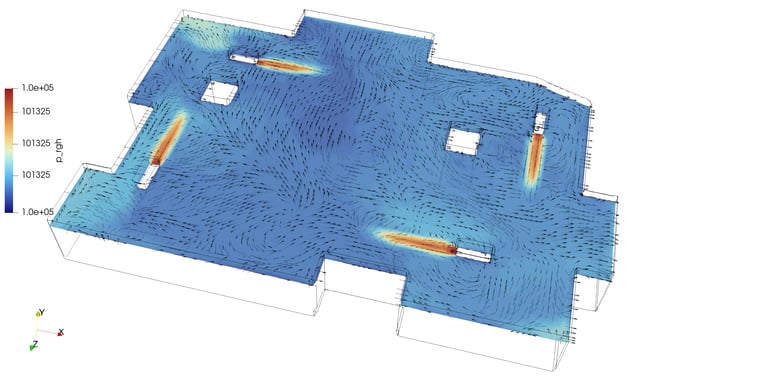
Car park geometry strongly influences air movement behavior. Large open spans may allow more uniform distribution, while long corridors, structural columns, or deep underground levels often create stagnant zones where air circulation is weak. Identifying these low-velocity regions is crucial, as they can become pockets of concentrated pollutants. Modern designs often adopt jet fans as key components, replacing large duct systems to improve air momentum and guide flow direction. Jet fans are arranged in systematic orientations to push air longitudinally toward extraction points. Their strategic positioning prevents short-circuiting between fresh inlets and exhaust locations, enhances mixing efficiency, and helps maintain a consistent air velocity field throughout the facility. Such jet-based systems have also proven to be more economical in installation and energy usage.
Sensor-based control is another important aspect, particularly for managing CO and NOx concentration. Instead of running ventilation at full capacity at all times, air quality sensors located around likely buildup areas—such as ramps, entry locations, or idle-traffic zones—signal when contaminants reach a threshold level and prompt a ventilation response. A demand-driven approach significantly reduces energy expenditures while ensuring pollutant levels remain safely below regulation limits. The system stays responsive to actual usage rather than operating blindly under worst-case assumptions.
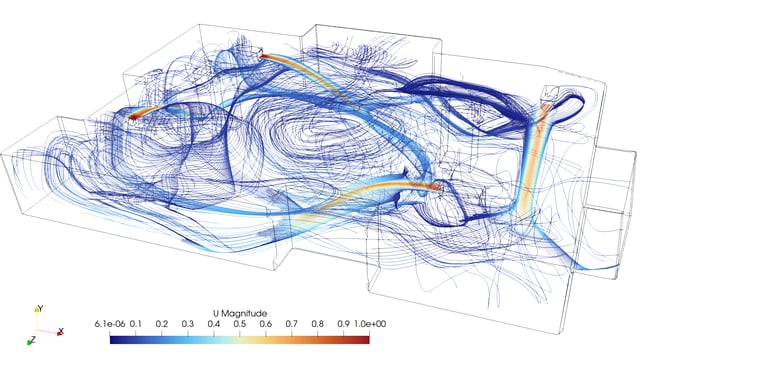
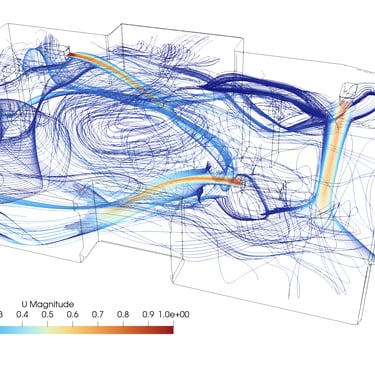
In the context of fire emergencies, airflow design becomes even more critical. The ventilation system must actively guide smoke toward extraction points while safeguarding evacuation routes. Fire-driven gases exhibit complex thermally induced buoyancy effects, forming layers that can obstruct visibility and compromise safety. To understand these dynamics, computational fluid dynamics (CFD) analysis has become a standard requirement. CFD provides insights into smoke plume behavior, temperature stratification, pressure distribution, and travel velocity. Multiple fire ignition locations—such as near exit ramps, vehicle clusters, or fresh-air openings—are typically tested to ensure a robust design that responds to worst-case scenarios. Results such as velocity contours, smoke movement patterns, or temperature fields are evaluated to confirm compliance and safety.
CFD simulation also plays an indispensable role in validating ventilation layouts for normal operation. Engineers assess how well fresh air spreads across the floor, locate stagnant zones, measure contaminant dispersion, and determine whether air pathways travel efficiently toward extraction fans. The simulation domain includes car blockages, jet fan thrust, pressure curves from equipment specifications, and air exchange through openings and shafts. By performing these virtual experiments, costly over-design can be avoided, and inadequate systems can be identified before construction begins. The final result is a layout that achieves both safety and energy economy.
Across many global building codes—whether governed by ASHRAE recommendations, NFPA guidelines, or local safety authorities—ventilation design must satisfy pollutant limits, extraction capacities, fire-mode switching protocols, and minimum air change rates. Yet adherence to standards alone does not guarantee optimal performance. Real-world car parks are influenced by occupant patterns, traffic loads, temperature gradients, and architectural limitations. This is why CFD-aided optimization has become the new baseline: it offers clarity, improves decision-making, and ensures the system is neither oversized nor vulnerable to inefficiencies.
Designing airflow in parking structures, therefore, involves merging architectural conditions, sensor strategy, fan directionality, extraction layout, and robust numerical validation. With simulations, engineers can explore multiple design alternatives in advance, evaluate their safety margins, and fine-tune the layout until pollutant dilution, extraction efficiency, and smoke-movement behavior reach satisfactory levels. In a field where safety, energy efficiency, and regulatory compliance intersect, CFD-assisted planning has become an essential engineering tool rather than a luxury.
Streamline Your Car Park Ventilation Design with tensorHVAC-Pro
If you are exploring CFD-based optimization for ventilation systems—whether it involves airflow uniformity, contaminant dispersion, jet fan configuration, or smoke evacuation during fire events—tensorHVAC-Pro offers a specialized simulation environment designed specifically for HVAC engineers. Equipped with automated meshing, scenario templates, and high-resolution solvers tailored to car park studies, tensorHVAC-Pro accelerates model preparation, reduces simulation time, and helps you validate every design with greater confidence.
Author: Wiratama
tensorHVAC-Pro is a dedicated HVAC flow and thermal simulation software, Intuitive and Easy to use, designed for HVAC engineers - not CFD expert. Learn more..
Read other case studies..