
Designing for Comfort: How Temperature and Airflow Work Together
When we think about comfort in a room, we often think of temperature first — the number we see on the thermostat. But true comfort isn’t determined by temperature alone. It’s shaped by how air moves and interacts with people and their surroundings. The perfect indoor environment is a careful balance of temperature, airflow, and humidity — and getting that balance right starts with simulation.
ARTICLES
Wiratama
10/14/20252 min read
Comfort Is More Than Just Cool Air
When we think about comfort in a room, we often think of temperature first — the number we see on the thermostat. But true comfort isn’t determined by temperature alone.
It’s shaped by how air moves and interacts with people and their surroundings. The perfect indoor environment is a careful balance of temperature, airflow, and humidity — and getting that balance right starts with simulation.
1. The Hidden Partner of Temperature: Airflow
Airflow is the messenger of temperature. It carries cooled or heated air throughout the space, blending it with the existing environment.
When airflow is too weak, cool air stagnates, creating warm zones. When it’s too strong, it can create uncomfortable drafts.
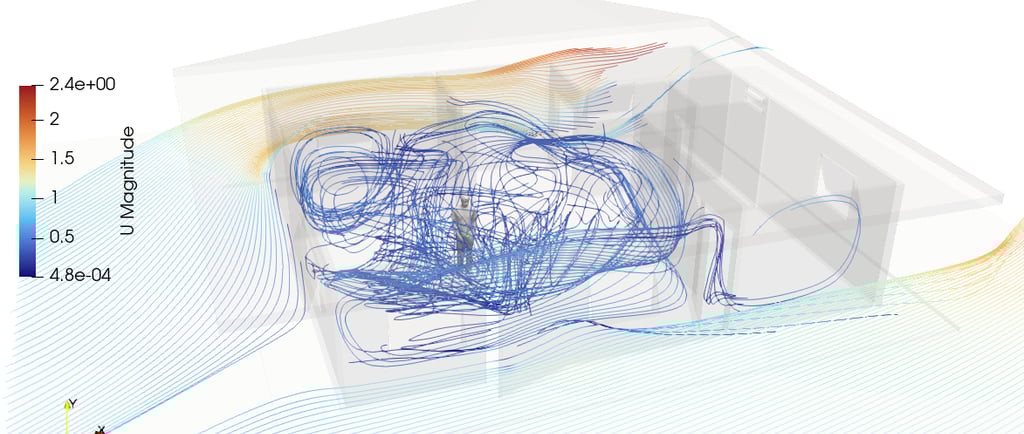
TensorHVAC-Pro helps engineers visualize this delicate interaction — showing exactly how air velocity and direction distribute temperature across a room.
With this insight, you can ensure that every occupant feels comfortable, no matter where they sit or stand.
2. Uniform Temperature Doesn’t Mean Uniform Comfort
Even if a thermostat reads 24°C, some areas may feel warmer or cooler depending on airflow distribution.
Air tends to stratify — warm air rises, cool air sinks — especially in tall spaces like offices, auditoriums, or factories.
With CFD simulation in TensorHVAC-Pro, you can analyze how temperature gradients form in 3D space and adjust diffuser placement, air velocity, and supply angles to maintain a consistent thermal environment.
3. The Role of Air Velocity
Comfort depends not only on air temperature but also on how fast the air moves.
Low velocity → Stuffy, warm feeling
High velocity → Drafty, uncomfortable sensation
For most indoor spaces, the ideal comfort velocity lies between 0.15 and 0.25 m/s. TensorHVAC-Pro allows engineers to test and visualize these flow rates, ensuring air moves just enough to refresh the space without disturbing occupants.
4. Achieving Balance Between Energy and Comfort
There’s a fine line between maintaining comfort and wasting energy. Overcooling a space to fix temperature imbalance only increases energy costs.
By optimizing airflow patterns through virtual testing, engineers can improve thermal mixing and eliminate problem zones — achieving comfort at lower power consumption.
That’s the kind of smart design that clients love — efficient, precise, and sustainable.
5. Visualizing Comfort Before Installation
Traditional design drawings can’t show how air behaves. Simulation can.
TensorHVAC-Pro provides colorful temperature maps and airflow visualizations that make it easy to see how design changes affect comfort.
You can test diffuser types, duct sizes, or room layouts in minutes — ensuring the final design feels as good as it looks.
6. Designing for People, Not Just Spaces
At the end of the day, HVAC systems are about how people feel, not just how systems perform.
By simulating temperature and airflow interaction, engineers can design environments that keep occupants comfortable, productive, and satisfied.
TensorHVAC-Pro turns physics into comfort — giving HVAC designers a way to predict how people will actually experience the space.
Comfort Is a Science — Now You Can Simulate It
The perfect indoor climate is not created by chance. It’s engineered through understanding how air moves, mixes, and delivers heat.
With TensorHVAC-Pro, you can see, measure, and optimize that process before installation — ensuring comfort that’s both consistent and efficient.
✅ Balance temperature. Control airflow. Perfect comfort.
That’s the science — and simplicity — of TensorHVAC-Pro.