
Designing Passive Ventilation in Buildings
Passive ventilation has become one of the most strategic approaches in sustainable building design, allowing architects and engineers to manage air quality, indoor comfort, and energy usage without depending heavily on mechanical equipment.
ARTICLESCASE-STUDIES
Wiratama
12/2/20253 min read
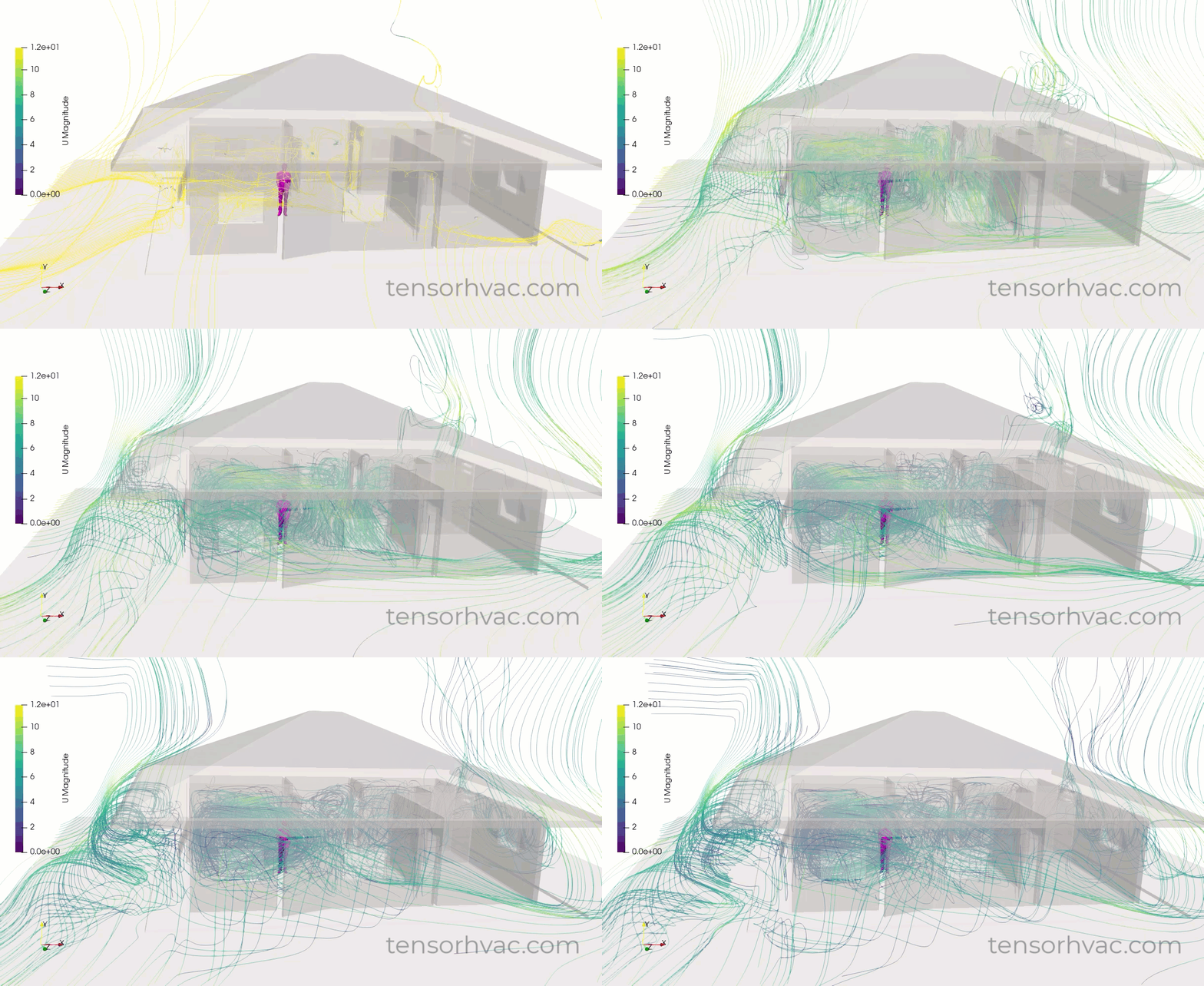
Passive ventilation has become one of the most strategic approaches in sustainable building design, allowing architects and engineers to manage air quality, indoor comfort, and energy usage without depending heavily on mechanical equipment. At its core, passive ventilation relies on natural forces—temperature differences, wind pressure, and buoyancy—to create continuous airflow through indoor spaces. When applied correctly, it can significantly reduce HVAC energy demand, minimize operational costs, and improve thermal and respiratory comfort for occupants. Designing effective passive ventilation requires a deep understanding of climate, terrain, building geometry, façade configuration, and internal thermal behavior.
The first principle to recognize is that airflow is driven by pressure differentials. Wind striking the windward side of a building increases local pressure, while leeward areas experience a reduction, creating a pressure gradient that can be harnessed to draw air through the interior. Architects strategically position openings, louvers, clerestory windows, and vertical shafts to allow outdoor air to enter from high-pressure zones and exit through low-pressure boundaries. This natural push-and-pull mechanism can remove indoor contaminants, maintain fresh oxygen levels, and lower humidity without fans or ducts. However, to maximize its effectiveness, the building orientation must be informed by prevailing wind direction, seasonal weather characteristics, and urban obstructions that may alter airflow patterns.
Stack effect is another cornerstone of passive ventilation. Indoors, warm air naturally rises because of its lower density. Vertical voids, atria, chimneys, and high-level vents can be designed to accelerate this buoyant flow. As warm air escapes near the top of the building, fresh cooler air is pulled in at lower levels, giving the building a self-sustaining circulation mechanism. In warm climates, this upward movement helps reduce heat accumulation, while in mixed climates it can be integrated with operable façade vents to release peak loads. Designers must consider the height of shafts, opening control, and the influence of temperature gradients on fan-less flow velocity. Proper stack-based planning also requires ensuring that air passages remain unobstructed and that exhaust paths do not recirculate back indoors.
Façade elements strongly influence the success of passive ventilation. Shading devices, double-skin façades, porous materials, and perforated cladding all play a role in shaping pressure zones and reducing heat gain. Double-skin façades, for example, can create a warm air buffer zone where solar heating drives upward airflow, forming a controlled exhaust channel. Night-purge ventilation strategies are often incorporated in temperate climates, allowing the building to flush out heat at night so that indoor thermal mass is reset to a cooler state for the following day. In this way, the façade becomes a climate-responsive interface, optimizing both energy and ventilation performance.
Interior planning is just as critical as exterior geometry. Open, unobstructed layouts promote natural crossflow, while misplaced walls, partitions, or mechanical spaces can block air pathways and create stagnant pockets. Engineers study how inlets and outlets should be sized and positioned to maintain stable airflow continuity from one side of the building to the other. Window elevation, atrium height, shaft diameter, corridor alignment, and habitable zone occupancy all determine internal flow resistance. Computational simulations are often applied to verify that ventilation reaches every occupied area, that thermal stratification is minimized, and that the design avoids recirculation zones with insufficient dilution.
Climate suitability and adaptability define the long-term success of passive ventilation systems. Tropical regions benefit from high-speed air motion that enhances human cooling through evaporation, whereas arid desert climates may rely more on nighttime infiltration and envelope ventilation. Cold climates require more moderation, where continuously open vents may cause excessive heat loss. Here, adjustable openings, insulated shafts, zoned ventilation, and hybrid configurations enable buildings to maintain fresh air while protecting internal thermal balance. The most well-designed passive strategies are not rigid—they respond intelligently to seasonal changes, occupancy loads, and indoor pollutant levels.
Because passive ventilation is intended to maintain healthy indoor environments, designers must also consider safety standards, filtration needs, and indoor air quality targets. Fresh air intakes cannot be oriented toward polluted external sources, and ventilation shafts must be assessed for fire scenarios to ensure they do not accelerate flame spread. Engineers often complement passive systems with controllable mechanical backup for extreme conditions, creating a fully resilient ventilation framework.
When thoughtfully integrated, passive ventilation unites architectural vision, environmental physics, and engineered airflow into a low-energy building ecosystem. By combining site-specific wind behavior, stack-driven air motion, façade intelligence, and simulation-based verification, designers can achieve indoor environments that feel natural, adaptive, and fundamentally sustainable—without depending on heavy mechanical infrastructure.
Validate and Optimize Passive Ventilation Designs with tensorHVAC-Pro
To ensure that passive ventilation concepts truly work under real climatic, geometric, and occupancy conditions, engineers increasingly turn to CFD simulation. tensorHVAC-Pro provides a specialized environment for evaluating airflow patterns, stack-effect performance, façade behavior, pollutant dilution, and indoor comfort levels. With automated meshing tools, passive-vent optimization features, and high-accuracy solvers, tensorHVAC-Pro helps designers validate their concepts before construction begins—ensuring that every passive system performs just as intended.
tensorHVAC-Pro is a dedicated HVAC flow and thermal simulation software, Intuitive and easy to use, designed for HVAC engineers - not CFD expert. Learn more..
Read other case studies..