Don’t Just Design Ducts — Predict How Air Really Flows
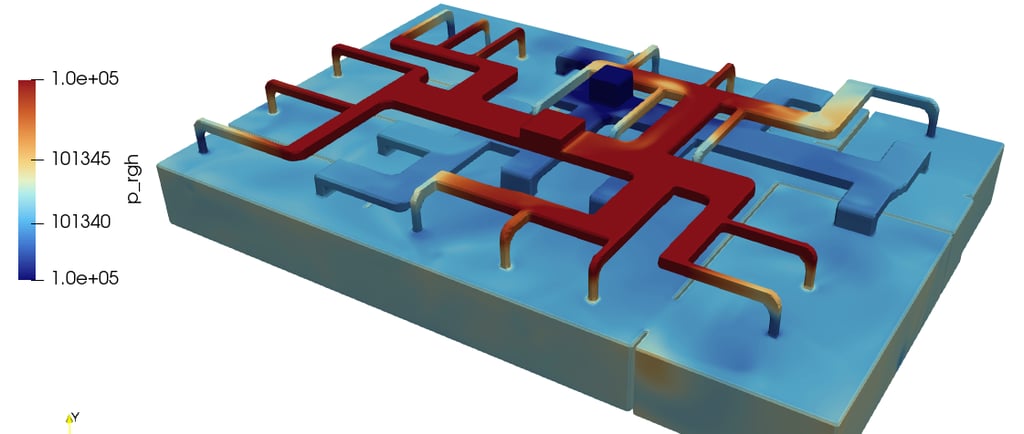
In traditional HVAC design, ducts, diffusers, and vents are drawn on a plan — clean lines on paper representing air movement in theory. But air doesn’t move in straight lines. It swirls, mixes, and bends around obstacles. That’s why designing ducts isn’t enough anymore. To achieve real comfort and efficiency, engineers must predict how air actually flows — and that’s where TensorHVAC-Pro makes the difference.
ARTICLES
Wiratama
10/14/20252 min read
Beyond Lines and Layouts
In traditional HVAC design, ducts, diffusers, and vents are drawn on a plan — clean lines on paper representing air movement in theory. But air doesn’t move in straight lines. It swirls, mixes, and bends around obstacles.
That’s why designing ducts isn’t enough anymore. To achieve real comfort and efficiency, engineers must predict how air actually flows — and that’s where TensorHVAC-Pro makes the difference.
1. What Drawings Can’t Show
Even the most detailed CAD layout can’t reveal what’s really happening inside the space.
You can’t see:
Whether air mixes evenly throughout the room
If cold air reaches the occupants or stays trapped at the ceiling
How pressure drops affect flow balance between diffusers
These are the invisible dynamics that separate a good HVAC system from a great one. TensorHVAC-Pro brings them to light with powerful yet accessible CFD (Computational Fluid Dynamics) simulation designed for HVAC professionals.
2. The Reality of Airflow
Air behaves like a living fluid. It interacts with walls, furniture, ceilings, and heat sources. Small design changes — a new wall partition, a different diffuser angle, or an offset return grille — can dramatically alter how air moves.
By simulating airflow with TensorHVAC-Pro, engineers can see these effects before installation, allowing them to refine the design early and avoid surprises later.
3. Find Problems Before They’re Built
Without simulation, issues often show up after the system is installed:
Rooms that feel stuffy despite adequate supply airflow
Uneven cooling or heating across zones
Unexpected noise or drafts
High static pressure and wasted fan energy
TensorHVAC-Pro detects these issues virtually, helping you fix them before construction — when changes are fast, simple, and inexpensive.
4. Optimize, Don’t Oversize
A common response to design uncertainty is oversizing fans or ducts “just in case.” But that drives up both installation and operating costs.
With simulation, you can validate airflow performance under real conditions — ensuring ducts are sized accurately, pressure losses are minimized, and fans work at their most efficient point.
That’s smart design backed by physics, not guesswork.
5. Turn Airflow Into a Visual Story
When you show clients a color-coded airflow map or temperature contour, they immediately understand your design’s value.
TensorHVAC-Pro helps transform technical analysis into visual proof — building client confidence and differentiating your proposals from competitors.
You’re no longer just an engineer; you’re a designer who can show comfort before it’s built.
6. The Future of HVAC Design Is Predictive
The industry is shifting from drawing-based to performance-based design.
TensorHVAC-Pro brings this future within reach by combining accuracy, affordability, and ease of use. You don’t need a supercomputer or PhD in fluid mechanics — just the curiosity to see how your design truly performs.
From Duct Lines to Real Airflow
Designing ducts defines where air should go.
Simulating airflow reveals how it really moves.
With TensorHVAC-Pro, you can bridge the gap between design and performance — creating systems that deliver comfort, efficiency, and confidence from the first day of operation.
✅ Visualize. Predict. Perfect.
That’s the next step in HVAC design — powered by TensorHVAC-Pro.