
Flow and Thermal Analysis of a Building
Blog post description.
ARTICLES
Wiratama
10/26/20253 min read
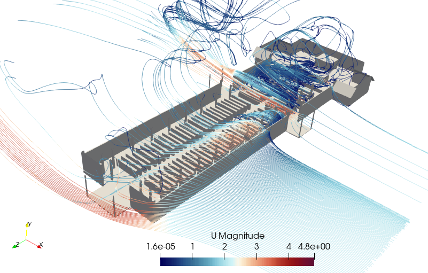
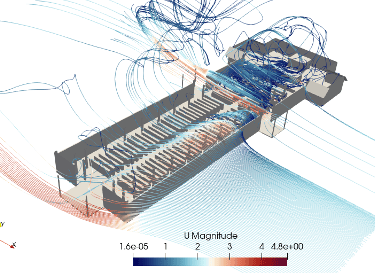
The performance of a building’s indoor environment depends heavily on how air and heat move within its spaces. Poor airflow, uneven temperature distribution, and thermal inefficiencies can lead to discomfort, excessive energy use, and even health issues. To address these challenges, engineers and architects use flow and thermal analysis—a simulation-based approach that predicts how air and heat behave inside a building. By understanding these physical interactions, designers can create spaces that are not only energy-efficient but also comfortable and healthy for occupants.
Understanding Flow and Thermal Behavior in Buildings
Inside any building, the flow of air and transfer of heat occur continuously. Air moves through openings, ducts, and occupied zones due to ventilation systems, pressure differences, and natural convection. At the same time, heat is transferred between walls, ceilings, windows, and air through conduction, convection, and radiation.
A flow analysis focuses on how air moves—its velocity, direction, and distribution—while a thermal analysis examines how temperature and heat spread throughout the building. When combined, these analyses provide a comprehensive understanding of how the indoor climate forms and evolves under different conditions.
Why Flow and Thermal Analysis Matters
Thermal Comfort Optimization
Uneven temperature distribution often causes discomfort, even when the thermostat shows ideal conditions. Flow and thermal simulations help ensure that air distribution and temperature gradients align with comfort standards such as ASHRAE 55, balancing temperature, humidity, and airflow to keep occupants comfortable.Energy Efficiency and HVAC Performance
By simulating air circulation and heat transfer, engineers can identify inefficiencies in HVAC systems, duct layouts, and insulation. Optimizing these parameters reduces fan energy consumption, prevents overcooling or overheating, and ensures balanced ventilation across zones.Indoor Air Quality (IAQ)
Proper airflow management prevents stagnant zones and ensures effective removal of contaminants. Flow simulations can reveal areas of low air exchange or high pollutant concentration, guiding the placement of diffusers, exhausts, and filtration systems.Design Validation Before Construction
Simulation-based analysis allows design validation early in the process. Engineers can test multiple HVAC configurations, façade materials, or shading systems virtually, minimizing costly changes during construction.Sustainability and Green Building Certification
Energy modeling and thermal simulations support compliance with sustainability certifications such as LEED, WELL, and BREEAM, all of which emphasize energy efficiency and occupant comfort.
How Flow and Thermal Analysis Is Performed
Modern flow and thermal analyses are typically carried out using Computational Fluid Dynamics (CFD) tools such as tensorHVAC-Pro. The process involves several key steps:
Geometry Modeling
The 3D model of the building or room is created, including walls, windows, HVAC diffusers, and heat sources such as lighting and occupants.Mesh Generation
The model is divided into small cells (a computational mesh), allowing the CFD software to solve flow and energy equations for each region of the space. Refinement is added near surfaces and areas with large gradients like vents or solar-exposed walls.Boundary and Initial Conditions
Air supply temperature, velocity, and humidity are defined at inlets, while exhausts or return vents are given outlet pressures. Heat sources (people, equipment, or solar radiation) are applied to simulate real conditions.Solver Setup
The software solves the Navier–Stokes equations for airflow and the energy equation for temperature distribution. Turbulence models like k–ε or k–ω SST are used to capture realistic indoor air behavior.Post-Processing
Results are visualized as contour plots, streamlines, and temperature maps. Engineers can evaluate parameters like air velocity near occupants, surface temperatures, and zones with poor ventilation or high heat accumulation.
Applications of Flow and Thermal Analysis in Building Design
HVAC System Optimization
Flow analysis helps determine the best diffuser type, location, and airflow rate for uniform temperature distribution. Thermal results show how supply air mixes with room air and how quickly comfort conditions are achieved.Natural Ventilation Design
CFD can simulate wind-driven or buoyancy-driven ventilation through windows, louvers, or atria. This analysis helps optimize opening sizes and placement for effective air exchange without excessive drafts.Solar and Envelope Performance
Thermal analysis of building envelopes evaluates how sunlight, shading devices, and insulation affect interior temperature. Designers can assess passive cooling or heating strategies to minimize HVAC load.Thermal Comfort Mapping
Simulations can calculate comfort indices such as PMV (Predicted Mean Vote) and PPD (Predicted Percentage Dissatisfied), offering a spatial map of comfort levels across different zones in a room.Data Centers and High-Load Spaces
Flow and thermal simulations are critical in spaces with concentrated heat loads, such as data centers or laboratories. CFD ensures that cold air reaches equipment efficiently and prevents hot spots.
Example: Office Building Airflow Analysis
Consider a typical open-plan office with ceiling diffusers and return grilles. Using CFD, engineers simulate the airflow and temperature field to assess comfort and ventilation efficiency. Results may reveal that certain desks experience higher velocities (causing drafts) while other areas remain stagnant. By adjusting diffuser orientation or air volume, the design achieves a more uniform temperature and air distribution. The outcome is improved comfort and reduced energy use—without changing the HVAC equipment size.
Benefits of Using CFD Simulation for Building Simulation
tensorHVAC-Pro, offers flexibility and cost-effectiveness for building analysis. It supports both laminar and turbulent flow modeling, buoyancy effects, and conjugate heat transfer, allowing engineers to simulate realistic indoor conditions. Its customizable framework makes it ideal for research and advanced design studies, enabling integration with energy modeling and control systems.
tensorHVAC-Pro is a dedicated flow and thermal HVAC simulation software designed for intuitive and easy to use for HVAC engineers - not CFD expert. Learn more..
Read other articles..