
Green Building Design: How Simulation can Help you get LEED certification
green building certifications like LEED (Leadership in Energy and Environmental Design) and ASHRAE Standard 189.1 provide frameworks for engineers to optimize performance, minimize environmental impact, and achieve measurable sustainability targets.
ARTICLES
Wiratama
11/10/20253 min read
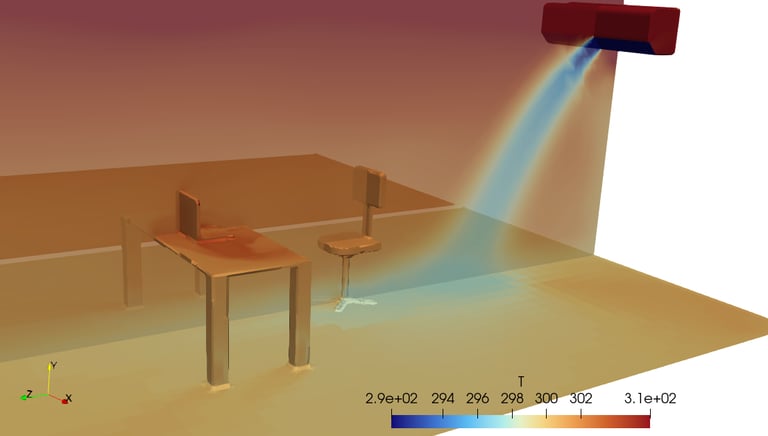
Globally, buildings consume a massive portion of the world’s energy, water, and raw materials. As sustainability becomes a key priority, green building design is rapidly transforming the architecture, engineering, and construction (AEC) industry.
To guide this transition, green building certifications like LEED (Leadership in Energy and Environmental Design) and ASHRAE Standard 189.1 provide frameworks for engineers to optimize performance, minimize environmental impact, and achieve measurable sustainability targets.
Understanding Green Building Standards
LEED Certification
Developed by the U.S. Green Building Council (USGBC), LEED is the most widely used green building rating system in the world. It evaluates projects based on a credit-based point system covering categories such as energy efficiency, indoor air quality, materials, and innovation in design.
Achieving LEED certification demonstrates a building’s commitment to sustainable practices and efficient resource use.
ASHRAE Standard 189.1
The ASHRAE 189.1 standard—known as the “Standard for the Design of High-Performance Green Buildings”—provides architects and engineers with a comprehensive framework for sustainable building design.
It builds upon other key ASHRAE standards:
90.1: Energy efficiency
62.1: Ventilation
55: Thermal comfort
By integrating these principles, ASHRAE 189.1 helps engineers align their designs with evolving environmental performance codes.
Active and Passive Design Strategies
A successful green building balances active and passive design approaches:
Passive strategies harness natural energy sources to minimize mechanical load. Examples include natural ventilation, solar heating, and shading systems that adapt to local climate conditions.
Active strategies use mechanical systems—such as HVAC units—to control indoor temperature, humidity, and air quality when passive means are insufficient.
In modern sustainable design, engineers aim to maximize passive methods while minimizing dependence on active systems. This results in lower operational costs and improved occupant comfort.
The Role of HVAC Systems in Green Buildings
HVAC systems are at the core of a building’s environmental performance. They influence:
Energy efficiency
Indoor air quality
Thermal comfort
Life-cycle operating costs
Design decisions made during early project stages have the greatest impact on sustainability outcomes. Engineers need tools that can predict real-world airflow, temperature distribution, and ventilation effectiveness—long before construction begins.
How CFD Simulation Supports Green Building Design
Computational Fluid Dynamics (CFD) simulation allows engineers to analyze airflow, temperature gradients, and heat transfer throughout a building.
By applying CFD early in the design process, HVAC and mechanical engineers can:
Validate compliance with LEED and ASHRAE 189.1 standards
Optimize air distribution for thermal comfort
Evaluate natural ventilation effectiveness
Reduce energy consumption through design refinement
CFD provides a level of insight that traditional design methods cannot match, helping teams make evidence-based design decisions that improve both comfort and sustainability.
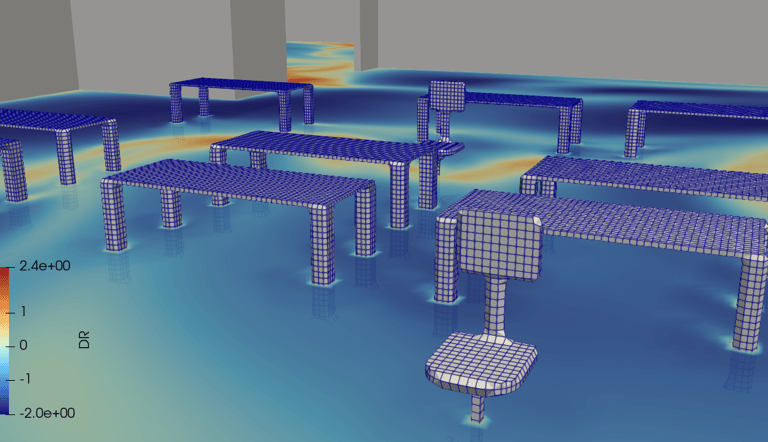
Case Study: Natural Ventilation and Thermal Comfort
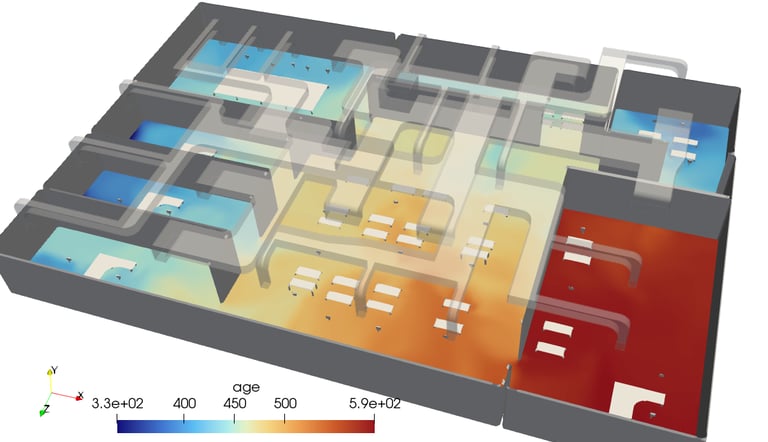
In practical applications, CFD enables engineers to visualize and validate complex airflows in spaces like classrooms, offices, or atriums.
Through simulation, one can assess:
Air velocity profiles for natural ventilation performance
Draft Rate (DR) to ensure comfort compliance
Hot and cold spot identification for HVAC layout optimization
Such analyses are essential for earning credits in LEED Energy & Atmosphere and Indoor Environmental Quality categories.
Why Investing in Green Building Design Pays Off
Many professionals assume green buildings are cost-prohibitive. In reality, studies show that the initial premium is typically less than 2%, while long-term savings exceed 10 times the investment over the building’s life cycle.
Benefits include:
Lower energy and maintenance costs
Enhanced occupant productivity
Increased property value and occupancy rates
LEED-certified buildings consistently achieve higher rental yields and resale values, proving that sustainability is both an environmental and financial advantage.
Simulation Made Simple for HVAC Engineers
Traditional CFD software can be complex, expensive, and time-consuming—often designed for CFD experts rather than HVAC professionals.
That’s why we created tensorHVAC-Pro — a dedicated HVAC flow and thermal simulation tool built specifically for engineers in the HVAC and building industry.
With tensorHVAC-Pro, you can:
Simulate airflow, temperature, and comfort distribution with ease
Optimize duct design, diffuser placement, and ventilation performance
Validate compliance with LEED and ASHRAE 189.1
Visualize results through intuitive, ready-to-use 3D outputs
Designed for HVAC engineers — not CFD experts, tensorHVAC-Pro helps bridge the gap between practical design and high-fidelity simulation.
tensorHVAC-Pro is a dedicated HVAC flow and thermal simulation software, Intuitive and easy to use, designed for HVAC engineers - not CFD expert. Learn more..
Download pdf version
Read more articles..