
How CFD Can Help Validate EN 15251 Compliance
Validating EN 15251 compliance is no longer just a regulatory checkbox — it’s a commitment to creating healthy, efficient, and comfortable indoor environments. With CFD simulation, engineers can go beyond assumptions and gain data-driven insight into how real airflow and temperature patterns affect occupant comfort.
ARTICLES
Wiratama
11/1/20253 min read
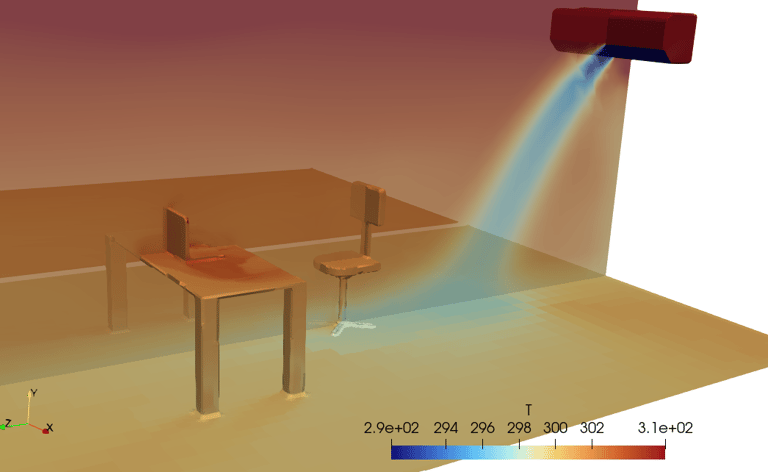
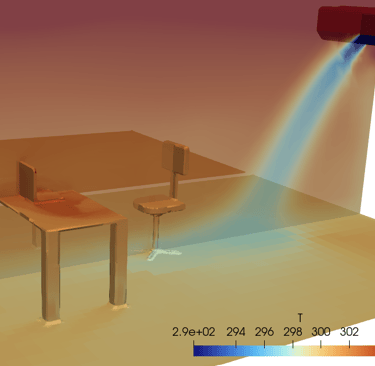
How CFD Can Help Validate EN 15251 Compliance
As energy-efficient and occupant-centered buildings become the global standard, achieving EN 15251 compliance (now evolved into EN ISO 17772-1) is a key target for HVAC engineers and designers. This European standard defines the indoor environmental parameters necessary to ensure thermal comfort, air quality, lighting, and acoustics for building occupants.
While manual calculations or static design tools can estimate conditions, they often fail to capture the real-world complexity of air movement and temperature variations. This is where Computational Fluid Dynamics (CFD) becomes a powerful validation tool.
What Is EN 15251?
EN 15251 specifies indoor environmental input parameters for building design and energy performance assessment. It focuses on ensuring:
Acceptable thermal comfort (based on PMV/PPD indices)
Adequate indoor air quality
Control of humidity and drafts
Proper ventilation rate distribution
Energy-efficient operation of HVAC systems
The standard divides indoor environments into four comfort categories (I to IV), where Category I represents high comfort for sensitive occupants, and Category IV represents an acceptable level for less critical environments.
Challenges in Manual Compliance Validation
Traditional compliance checks rely on simplified assumptions, such as uniform air temperature or average airspeed. However, real buildings rarely behave this way. Airflow patterns are affected by:
Furniture arrangement
Diffuser position
Occupant heat load
Solar gain and external walls
Natural ventilation effects
Because of these variations, manual methods can underestimate local discomfort zones — leading to non-compliance even when design calculations seem correct.
How CFD Helps Validate EN 15251 Compliance
CFD (Computational Fluid Dynamics) provides a 3D, physics-based simulation of airflow and temperature inside the building. It allows engineers to visualize and quantify all parameters defined in EN 15251, including:
Air Velocity Distribution
CFD maps how air moves through diffusers, across occupants, and around obstructions. This helps assess whether airflow speed stays within EN 15251 limits to prevent drafts (especially for Categories I and II).Temperature Uniformity
The standard specifies that vertical temperature differences (e.g., between head and ankle level) should not exceed certain values. CFD provides precise cross-sectional temperature data, validating compliance.Predicted Mean Vote (PMV) and Predicted Percentage of Dissatisfied (PPD)
CFD software like tensorHVAC-Pro can calculate PMV and PPD indices across the room, automatically classifying zones according to EN 15251 categories — without manual point-by-point calculations.Air Age and Ventilation Effectiveness
CFD shows how quickly air is renewed in different zones, identifying stagnant areas or regions with insufficient ventilation, crucial for maintaining good indoor air quality.Humidity and Radiant Asymmetry Effects
Through coupled thermal analysis, CFD can model radiant heat transfer from walls, windows, and occupants, ensuring total comfort compliance across all boundary conditions.
Practical Steps for CFD-Based Validation
Model the Room or Building Zone
Import geometry from CAD or BIM software and define air supply, exhaust points, and heat sources.Simulate Airflow and Heat Transfer
Run steady-state or transient CFD simulations to capture airflow, temperature, and turbulence patterns.Analyze Comfort Parameters
Use CFD outputs to generate PMV, PPD, air velocity, and temperature contour maps.Compare Results With EN 15251 Criteria
Verify whether each comfort zone falls within the defined category limits (e.g., PMV between -0.5 and +0.5 for Category I).Optimize Design if Needed
Adjust diffuser positions, airflow rates, or HVAC load distribution to improve compliance.
Using tensorHVAC-Pro for EN 15251 Validation
tensorHVAC-Pro simplifies CFD analysis for HVAC professionals who aren’t CFD experts. It provides an intuitive interface for:
Setting boundary conditions for rooms or ducts
Running thermal and flow simulations quickly
Displaying PMV, PPD, temperature, and velocity maps
Generating visual reports that directly align with EN 15251 criteria
This makes it a practical tool for HVAC engineers, consultants, and green building designers seeking to prove comfort compliance efficiently and affordably.
Benefits of Using CFD for EN 15251 Compliance
Visual Proof: CFD results provide clear visual evidence of compliance for design reports and certification documentation.
Design Optimization: Early simulation helps adjust layouts before costly installations.
Energy Efficiency: Ensures comfort is achieved with minimum energy use, supporting LEED and BREEAM credits.
Risk Reduction: Identifies potential non-compliance or comfort issues before construction.
Conclusion
Validating EN 15251 compliance is no longer just a regulatory checkbox — it’s a commitment to creating healthy, efficient, and comfortable indoor environments.
With CFD simulation, engineers can go beyond assumptions and gain data-driven insight into how real airflow and temperature patterns affect occupant comfort.
And with software like tensorHVAC-Pro, this process becomes accessible to every HVAC professional — combining scientific accuracy with simplicity.
By integrating CFD into your design workflow, you can ensure every project not only meets EN 15251 standards but also sets a new benchmark for performance-driven indoor environments.
tensorHVAC-Pro is a dedicated HVAC flow and thermal simulation software, Intuitive and easy to use, designed for HVAC engineers - not CFD expert. Learn more..
Read more articles..