
How Does a Home’s Humidity Impact Indoor Comfort?
Humidity is a critical factor in indoor comfort—just as important as air temperature. It shapes how we perceive warmth, influences our health, and affects the durability of our homes.
ARTICLES
Wiratama
11/24/20253 min read
How Does a Home’s Humidity Impact Indoor Comfort?
When we think about creating a comfortable indoor environment, temperature is usually the first factor that comes to mind. However, humidity plays an equally important—yet often overlooked—role in how we perceive comfort inside our homes. The amount of moisture in the air affects not only how warm or cool a space feels, but also indoor air quality, personal health, and the condition of furniture, walls, and building materials.
Understanding humidity is essential for maintaining a healthy and pleasant living space.
Why Humidity Matters for Indoor Comfort
Humidity refers to the amount of water vapor in the air. Both excessively high and excessively low humidity can significantly affect how we feel in a room.
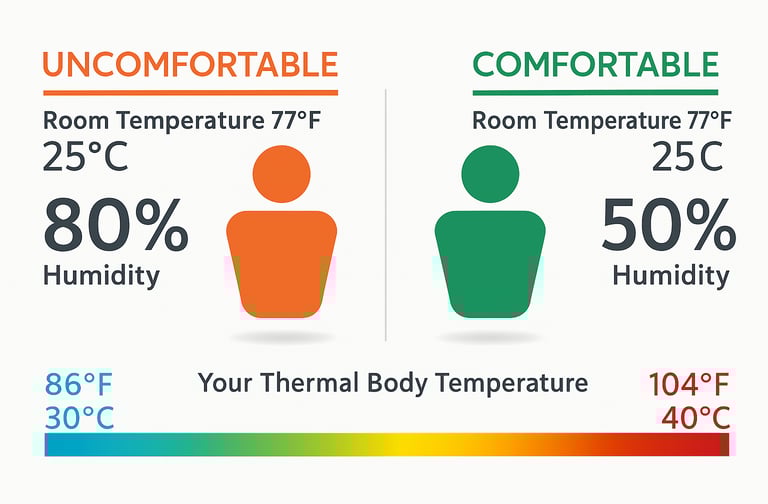
High humidity makes the air feel warmer because sweat evaporates more slowly. This reduces the body’s ability to cool itself, often leading to discomfort, stuffiness, and increased risk of mold growth.
Low humidity has the opposite effect. It speeds up evaporation, making the air feel cooler than the thermostat setting. This can dry out skin, irritate the respiratory system, and damage wood surfaces.
Most people feel most comfortable when indoor relative humidity is between 40% and 60%. Outside this range, even a “perfect” temperature may feel wrong—too warm, too cold, or simply uncomfortable.
The Science Behind Humidity and Perceived Temperature
Humidity has a strong influence on perceived temperature, often called the “feels-like” temperature. This is because perspiration—the body’s main cooling mechanism—depends on how quickly sweat evaporates from the skin.
When humidity is high, the air already contains a large amount of water vapor. Sweat evaporates slowly, so the body retains heat and feels warmer.
When humidity is low, air has more capacity to absorb moisture. Sweat evaporates quickly, creating a cooling effect.
This is why, for example:
A room at 75°F (24°C) with 55% humidity can feel pleasantly comfortable.
The same room at 75°F with 80% humidity can feel hot and sticky.
At 75°F with 20% humidity, it may feel chilly and dry.
These sensations are rooted in evaporation physics and the body’s thermal regulation.
The Role of HVAC Systems in Humidity Control
Air conditioners and heat pumps reduce humidity as a by-product of the cooling process. Warm indoor air passes over a cold evaporator coil, causing moisture to condense and drain away. This incidental dehumidification is one reason cooling feels refreshing on humid days.
However, HVAC systems are not designed to control temperature and humidity independently. Oversized systems often cool the air too rapidly, shutting off before enough moisture is removed—leading to cold but humid conditions. Proper equipment sizing, airflow control, and runtime duration all influence humidity levels.
In very humid climates, additional strategies such as whole-home dehumidifiers may be recommended to maintain comfortable humidity levels and protect building materials.
Simulating Humidity Behavior with Modern Tools
Indoor humidity behaves dynamically—rising in some zones, settling in others, and interacting with airflow, heat sources, and room geometry. Because of this complexity, engineers increasingly rely on advanced simulation tools, such as CFD (Computational Fluid Dynamics), to visualize airflow patterns, humidity movement, and comfort indicators.
Tools like tensorHVAC-Pro use 3D simulations to help engineers and designers better understand:
How humidity accumulates in certain corners
How ventilation affects moisture removal
How temperature and humidity interact to influence comfort (PMV/PPD)
Where condensation risks may occur
These insights support better HVAC design, improved indoor comfort, and more energy-efficient solutions.
Conclusion
Humidity is a critical factor in indoor comfort—just as important as air temperature. It shapes how we perceive warmth, influences our health, and affects the durability of our homes. By understanding how humidity interacts with airflow and heat sources, homeowners and HVAC professionals can make more informed decisions about ventilation, insulation, and comfort strategies.
Modern airflow and thermal analysis tools now make it easier than ever to predict how humidity behaves inside the home, enabling more effective comfort management and healthier living environments.
Download pdf version
tensorHVAC-Pro is a dedicated HVAC flow and thermal simulation software, Intuitive and Easy to use, designed for HVAC engineers - not CFD expert. Learn more..
Read more articles..