
How to Calculate Wind Load on a Building
How to Calculate Wind Load on a Building
ARTICLES
Wiratama
12/4/20253 min read
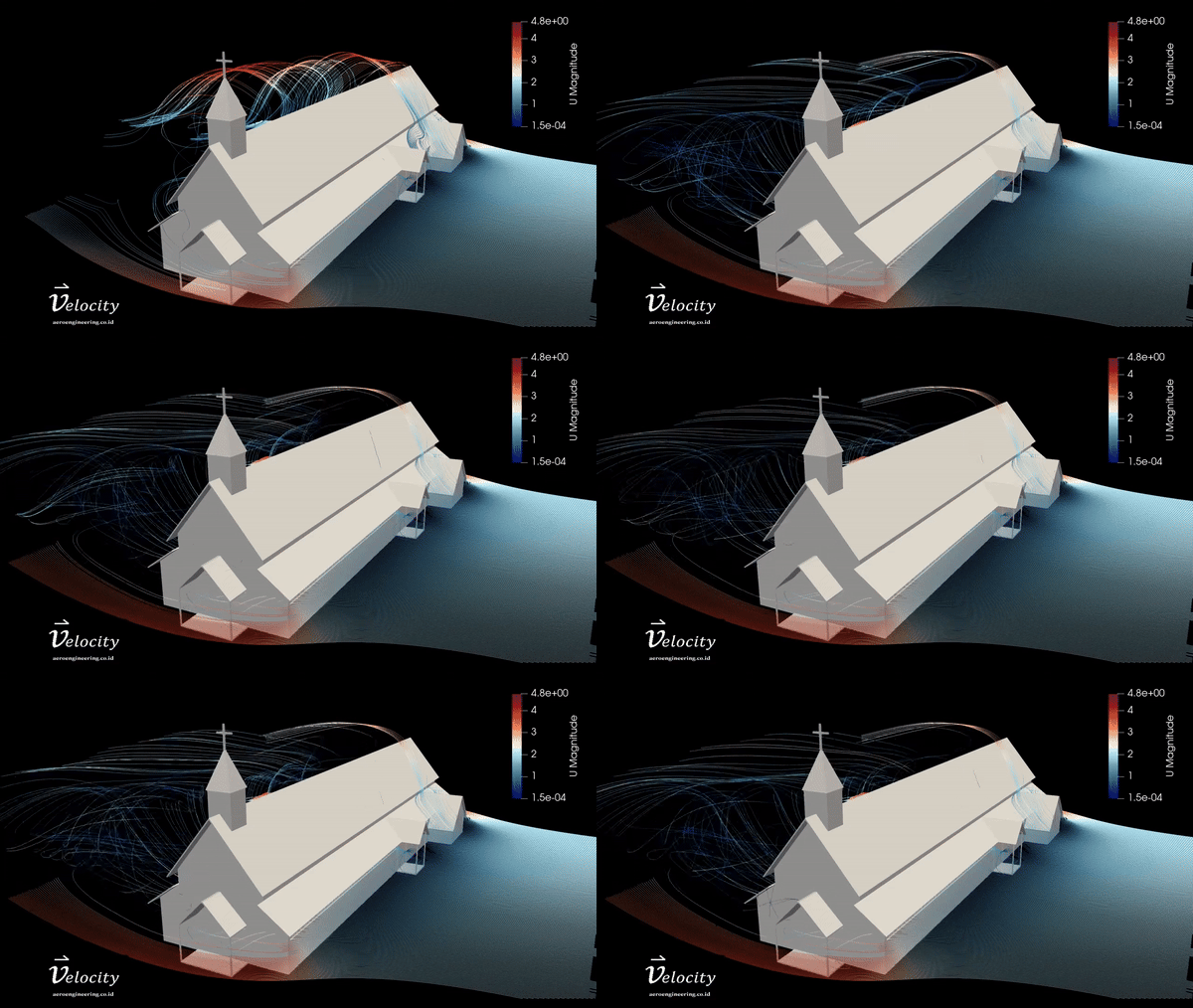
Accurate wind load predictions are a fundamental requirement in building design. Tall buildings, complex geometries, dense urban layouts, and regions with high wind velocity all demand careful evaluation of wind pressure, dynamic response, and structural stability. Making the right decisions early helps prevent structural failures, avoid costly redesigns, and ensure occupant comfort and safety.
Computational fluid dynamics (CFD) supports this process by allowing design teams to test how wind interacts with a structure virtually, long before construction begins. Instead of relying only on simplified formulae or expensive wind tunnel testing, numerical simulation provides detailed insights into pressure fields, vortex shedding, and aerodynamic performance during concept development.
What Is Wind Load Analysis?
Wind load analysis evaluates the impact of wind pressure, fluctuating forces, and aerodynamic phenomena acting on a structure. Two main considerations guide this process:
1. Pressure Loads and Envelope Design
Buildings are subjected to positive and negative pressure zones depending on wind direction, local shape, and surrounding geometry. These pressures govern façade reinforcement, cladding attachment, anchoring systems, and safety margins. While simplified building codes may be sufficient for basic geometries, more complex shapes generally require higher-resolution simulation to capture peak loads accurately.
2. Dynamic Effects and Vortex Shedding
Tall structures with slender forms are especially sensitive to unsteady crosswind forces caused by vortex shedding. When the shedding frequency aligns with the building’s natural frequency, resonant oscillation can occur, amplifying motion and potentially threatening structural integrity. Design decisions that weaken vortex formation can significantly reduce these risks.
Design Strategies to Reduce Wind Effects
Wind-induced loads and dynamic forces can be mitigated through several geometric strategies, including:
Corner softening
Height tapering or variable cross-section
Flow disruption elements
Porosity or bleed openings
Aerodynamic shaping
These modifications are typically evaluated iteratively, and CFD is well-suited to predict whether each change meaningfully reduces vortex strength, improves pressure distribution, or lowers oscillation amplitude.
CFD for Building Wind Load Studies
Numerical simulation can be used to model a virtual wind tunnel around a building geometry, including atmospheric boundary layer profiles. Simulations offer:
Detailed pressure and force maps
Velocity contour fields
Identification of recirculation regions and vortex zones
Time-based dynamic force predictions
Multiple design variations can be evaluated in parallel to identify the most resilient configuration.
Example: Mitigating Vortex Shedding
Consider a 50-story tower exposed to a 45 m/s wind. Two designs can be compared:
Square prism with sharp edges
Same geometry with softened or rounded corners
Transient flow simulation reveals that sharp corners shed strong alternating vortices, generating high crosswind forces. In a case like this, the shedding frequency may approach the building’s natural frequency, increasing the risk of amplified motion.
Rounded corners, however, diminish the strength of vortex formation. This reduces crosswind oscillation amplitude and lowers peak dynamic forces, contributing to both structural safety and occupant comfort.
How CFD Supports Decision-Making
Wind load considerations influence architectural form, structural sizing, cost, and compliance. Early-stage flow simulation supports:
Safer façade attachment design
Confirmation of structural stiffness and damping requirements
Reduced material use through optimized reinforcement
Cleaner pedestrian airflow around the building base
Sustainable design strategies through aerodynamic shaping
Instead of relying solely on standardized coefficients or late-stage wind tunnel checks, virtual testing assists in guiding designers toward more resilient solutions from the outset.
Conclusion
Wind load predictions are an essential part of the building design process, especially for tall, irregular, or exposed structures. By understanding pressure zones, flow separation, and vortex-induced motion, designers can shape buildings that are safer, more durable, and more efficient.
CFD simulation brings clarity to these decisions, enabling the rapid comparison of design options and the early discovery of aerodynamic issues before construction plans are finalized. Whether evaluating façade pressure, tuning building shape, or mitigating vortex shedding, simulation helps ensure that wind-related risks are addressed well before a structure is built.
Elevate Your Wind Engineering Workflow with tensorHVAC-Pro
For architects, engineers, and building modelers analyzing wind pressure, aerodynamic shaping, or crosswind vibration, tensorHVAC-Pro provides CFD capabilities tailored to building performance. Its solvers, visualization tools, and comparative design modules help you assess wind load scenarios and refine structural concepts with greater confidence before finalizing your design.
tensorHVAC-Pro is a dedicated HVAC flow and thermal simulation software, Intuitive and easy to use, designed for HVAC engineers - not CFD expert. Learn more..
Read more articles..