
HVAC Duct Sizing Calculation
Step-by-step how to calculate HVAC ductwork size, equipped with online free Calculator
ARTICLES
Wiratama
11/12/20253 min read
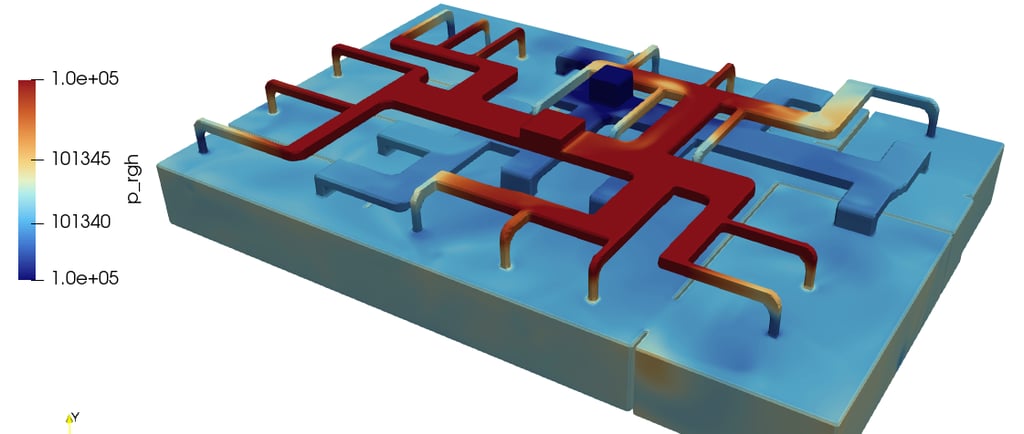
HVAC Ductwork Sizing Guide
Incorrect HVAC duct sizing can cause similar issues to an improperly sized HVAC unit. When ducts are too large or too small, they can lead to poor airflow, higher energy costs, unwanted noise, and early wear on components. These problems can leave customers disappointed after investing in a new HVAC system or duct upgrade.
To prevent these issues, many technicians use HVAC duct sizing calculators, to confirm accurate measurements before installation. But, before we use the calculator, lets discuss how to calculate Duct size step-by-step.
Figure the Square Footage of Each Space
Duct sizing begins with knowing the square footage of the home or building—especially the size of each individual room.
For rectangular rooms, the area is easy to calculate:
Area = Length × Width
Example:
A 10 ft × 10 ft room has:
10 × 10 = 100 sq ft
For irregular rooms, such as L-shaped spaces, divide the room into smaller rectangles, calculate each area, then add them together for the total square footage.
Determining Air Duct Size Using Air Velocity
Airflow (velocity) is measured in CFM—cubic feet per minute.
Since CFM directly determines duct size, you must calculate the required CFM for each room. If you skip room-by-room calculations, some rooms may be too hot or too cold.
To find CFM, start with a Manual J load calculation.
This tells you how many BTUs per hour each room needs, as well as the total load for the entire building.
Sizing the HVAC Unit
Once you know the total BTU load, you can determine the proper HVAC equipment size.
1 ton = 12,000 BTUs
Equipment tons = Total BTUs ÷ 12,000
Example:
24,000 BTUs ÷ 12,000 = 2 tons
Next, estimate the system’s airflow.
Most systems deliver about 400 CFM per ton.
Example:
2 tons × 400 CFM = 800 CFM total system airflow
Note: Cooling systems typically run between 350–400 CFM/ton, while heating airflow is lower (around 65% of cooling airflow). To stay safe, use 400 CFM per ton when sizing ductwork.
Duct CFM Calculation for Each Room
To find the airflow each room needs:
Room CFM = (Room Load ÷ Total Load) × Equipment CFM
Example:
Room Load = 2,000 BTUs
Total Load = 24,000 BTUs
Equipment Airflow = 800 CFM
Calculation:
(2,000 ÷ 24,000) × 800 = 66.67 CFM
Rule of thumb:
Standard rooms: 1 CFM per 1–1.25 sq ft
Rooms with big windows or direct sun: 2 CFM per sq ft
Figure the Friction Loss Rate
Friction Rate (FR) helps determine what duct diameter and shape will maintain proper airflow.
It is calculated using the Available Static Pressure (ASP) and the Total Effective Length (TEL) of the duct system:
Friction Rate = (ASP × 100) ÷ TEL
A higher friction rate enables the use of smaller ducts.
A lower friction rate requires larger ducts because the system has less pressure available to overcome resistance.
To find ASP, check the blower’s external static pressure from the manufacturer’s CFM chart, then subtract the pressure losses from added components (filters, coils, grilles, dampers).
Typical component pressure drops:
Supply register: 0.03 in wc
Return grille: 0.03 in wc
Balancing damper: 0.03 in wc
Filter: see manufacturer rating
You must not exceed the available static pressure, or airflow will be inadequate.
Total Effective Length (TEL)
TEL represents the total airflow path from the farthest supply outlet, through the air handler, to the farthest return.
It includes:
Straight duct runs
Turns
Fittings
Branch connections
Each fitting has an “equivalent length,” which converts its pressure drop to an equal length of straight duct.
TEL = Straight Length + Equivalent Length of All Fittings
Example:
Straight duct = 50 ft
Fittings = 150 ft equivalent
TEL = 50 + 150 = 200 ft
Now calculate friction rate:
External static pressure @ 1000 CFM = 0.5 in wc
Pressure drops:
Register = 0.03
Grille = 0.03
Filter = 0.15
ASP = 0.5 − (0.03 + 0.03 + 0.15)
ASP = 0.29 in wc
Friction Rate = (0.29 × 100) ÷ 200
Friction Rate = 0.145 in wc per 100 ft
tensorHVAC-Pro is a dedicated HVAC flow and thermal simulation software, Intuitive and easy to use, designed for HVAC engineers - not CFD expert. Learn more..
Read more articles..