
HVAC Ducting design with Computational Fluid Dynamics
HVAC Ducting design with Computational Fluid Dynamics
ARTICLESCASE-STUDIES
Wiratama
12/2/20252 min read
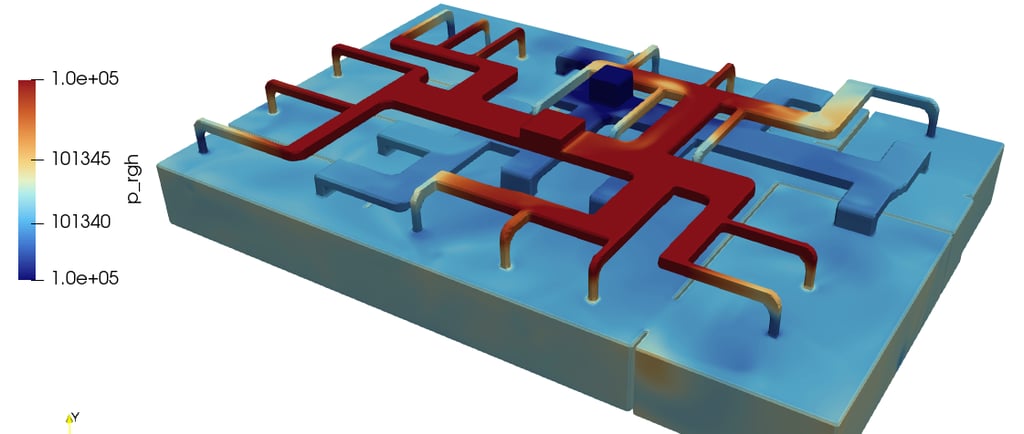
Fluid flow simulation plays a vital role in the design of inlet ducts for apparatus engineering, enabling engineers to refine internal channels and produce more uniform flow distribution that improves overall system performance. In this example project, the objective was to achieve a homogeneous velocity field in front of a process apparatus, as even minor variations in flow uniformity can significantly influence operational efficiency. The installation geometry of ducts and flow-conditioning components often dictates the quality of the incoming stream, making early design validation essential in plant environments where reliability and thermal performance are critical.
A series of duct configurations were created in CAD and evaluated virtually through flow simulation to understand how the design shape affected velocity patterns. By studying the numerical results at early stages—long before fabrication—engineers were able to predict recirculation zones, low-momentum pockets, and turbulent behaviors that could lead to uneven loading on downstream equipment. Multiple design variants were analyzed, each processed with computational meshing and post-simulation visualization. These virtual studies made it possible to test flow uniformity, examine channel losses, and observe how subtle geometric adjustments influenced separation points and swirl intensity. Rather than relying solely on empirical assumptions or prototype testing, simulation provided detailed insight into the fluid mechanics governing the duct.
One key comparison involved two designs: the baseline duct and a modified version incorporating turning vanes at the corner. The baseline design exhibited a large recirculation region, causing the effective flow channel to contract significantly and produce highly non-uniform discharge near the outlet plane. In contrast, the design with turning vanes guided flow smoothly through the bend, restored channel utilization across the full width, and delivered a substantially more uniform velocity distribution at the outlet. Streamline patterns clearly revealed that the added vanes suppressed corner-induced vortices and reduced turbulence intensity, delivering a controlled flow field aligned with the project target. The improvement demonstrated how even a small investment in simulation during the design phase can lead to a dramatic enhancement in final performance.
By validating duct behavior through fluid flow simulation, engineers made confident design decisions without iterative physical prototyping. They gained access to detailed flow physics, assessed design concepts rapidly, and ensured that the final duct geometry delivered controlled transport, reduced energy loss, and strengthened system reliability.
Accelerate Duct Design Optimization with tensorHVAC-Pro
For apparatus engineering projects that depend on uniform flow delivery, tensorHVAC-Pro offers specialized CFD tools for duct simulation, turbulence prediction, velocity visualization, and rapid design iteration. With automated meshing, powerful solvers, and targeted HVAC-flow features, tensorHVAC-Pro enables engineers to verify flow uniformity, reduce recirculation, and fine-tune duct geometry early in the design cycle—turning simulation insights into measurable system performance.
tensorHVAC-Pro is a dedicated HVAC flow and thermal simulation software, Intuitive and easy to use, designed for HVAC engineers - not CFD expert. Learn more..
Read more articles..