
Natural Convection Ventilation flow and thermal simulation
Natural Convection Ventilation flow and thermal simulation
CASE-STUDIES
Wiratama
10/17/20252 min read
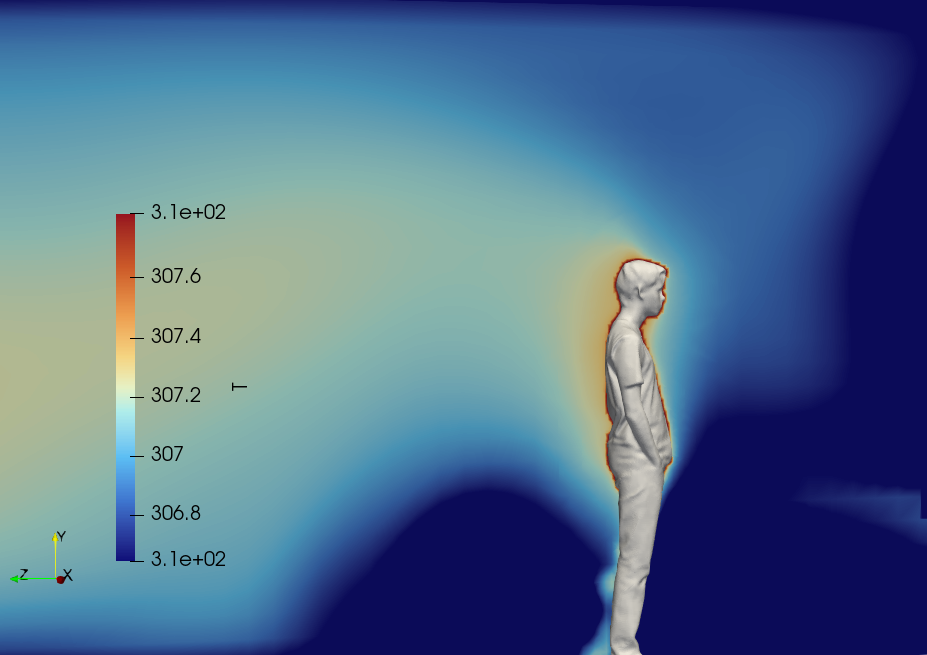
Simulating Natural Convection Ventilation Using tensorHVAC-Pro
Natural convection ventilation—also known as buoyancy-driven ventilation—is a passive airflow mechanism that relies on temperature differences between indoor and outdoor environments. Warm air naturally rises, cool air sinks, and the resulting density variations create a pressure gradient that drives airflow without mechanical fans. Understanding this phenomenon is essential for designing energy-efficient buildings, improving occupant comfort, and reducing operational costs.
tensorHVAC-Pro provides a dedicated and streamlined workflow for simulating natural convection ventilation using advanced Computational Fluid Dynamics (CFD) technology. Built on the robust OpenFOAM framework, the software automatically handles geometry preparation, meshing, solver configuration, and post-processing, allowing engineers to focus on interpreting results rather than managing complex CFD tools.
Why Natural Convection Matters in Ventilation Design
In many building designs—especially in warm climates or low-energy buildings—natural ventilation plays a significant role in:
Minimizing reliance on HVAC mechanical systems
Reducing energy consumption
Enhancing indoor air quality
Mitigating overheating
Improving thermal comfort through natural airflow movement
However, natural convection is highly sensitive to subtle factors such as window placement, wall temperature, solar loads, and indoor heat sources. This makes predictive CFD modeling invaluable for understanding how air will actually behave inside the space.
How tensorHVAC-Pro Simulates Natural Convection
1. Automatic Geometry Preparation
Users can import room geometry into tCFD-Pre, where walls, openings, objects, and heat sources are organized and named according to tensorHVAC-Pro conventions. Minimal or zero cleanup is required thanks to automated STL handling.
2. Automatic Meshing
tensorHVAC-Pro automatically generates a high-quality mesh using a hybrid blockMesh + snappyHexMesh workflow. Users simply choose between Coarse, Medium, or Fine mesh resolutions. The software refines around openings, walls, and internal objects to ensure accurate buoyancy-driven flow prediction.
3. Buoyancy Modeling with buoyantSimpleFoam
The core of natural convection simulation is the buoyantSimpleFoam solver, which captures:
Temperature-driven density variations
Rising warm air plumes
Sinking cool air streams
Pressure differences that drive airflow
Thermal stratification layers
The solver operates in steady-state mode, making it ideal for analyzing equilibrium natural ventilation patterns.
4. Thermal Boundary Conditions
Users can easily assign temperature values to walls, windows, floors, and openings. tensorHVAC-Pro automatically configures:
Hot or cold surfaces
Inflow and outflow through open windows
Internal heat sources (people, equipment, lighting)
These boundary conditions allow the software to simulate realistic indoor microclimates.
Visualizing the Results in ParaView
Once the simulation completes, tensorHVAC-Pro outputs the results in ParaView-compatible format. Engineers can explore:
Temperature distribution
Velocity magnitude and airflow vectors
Thermal stratification
Pressure differences at openings
Draft Rate (DR)
Air age or ventilation effectiveness
Section planes, streamlines, wireframe views, and “Cell to Points” smoothing help users clearly visualize buoyancy-driven motion and identify inefficient or stagnant zones.
Applications of Natural Convection Simulation
Simulations generated with tensorHVAC-Pro are valuable for:
Designing window placement for passive cooling
Evaluating cross-ventilation performance
Assessing the impact of wall and roof temperature
Identifying stagnant or poorly ventilated corners
Optimizing geometry for natural airflow enhancement
Reducing reliance on mechanical HVAC systems
This helps architects, HVAC engineers, and sustainability consultants make data-driven decisions early in the design phase.
Conclusion
Natural convection ventilation is a powerful strategy for achieving low-energy, comfortable indoor environments. With tensorHVAC-Pro, simulating this complex phenomenon becomes fast, intuitive, and highly accurate. By integrating automated geometry tools, intelligent meshing, advanced buoyancy solvers, and effortless post-processing, tensorHVAC-Pro empowers engineering teams to understand and optimize natural ventilation designs with unprecedented clarity.