
Optimizing Data Center Cooling Efficiency with CFD Simulation and ASHRAE Standards
As global energy demands rise, data center efficiency has become a critical engineering challenge. By following ASHRAE 90.4 standards and leveraging CFD simulation, designers can optimize HVAC performance, reduce operational costs, and enhance sustainability — all without compromising reliability or uptime.
ARTICLESCASE-STUDIES
Wiratama
11/3/20254 min read
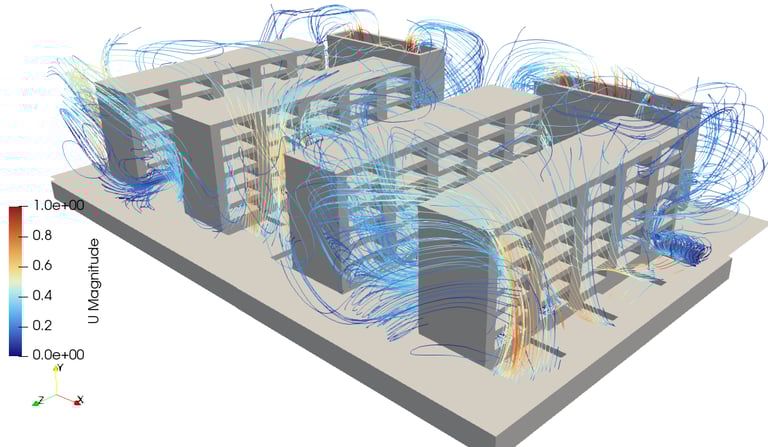
Optimizing Data Center Cooling Efficiency with CFD Simulation and ASHRAE Standards
Modern data centers are the backbone of the digital economy — operating 24/7 to power communication, finance, science, and technology around the globe. However, this reliability comes at a cost: these facilities are energy-intensive, consuming roughly 3% of the world’s total electricity and growing by nearly 4.4% each year. The largest portion of this energy is used for cooling, making the efficiency of HVAC (Heating, Ventilation, and Air Conditioning) systems one of the top priorities for data center designers.
The Challenge of Energy Efficiency in Data Centers
Studies show that cooling systems account for about 50% of a data center’s total energy consumption — more than servers and storage combined. With rising energy prices and the growing demand for digital infrastructure, optimizing HVAC performance has become essential not only for sustainability but also for cost control and system reliability.
To address this, the American Society of Heating, Refrigerating, and Air-Conditioning Engineers (ASHRAE) developed specific standards to guide energy-efficient design and operation for data centers.
ASHRAE Standards for Data Center Cooling
Historically, energy performance in data centers was measured using Power Usage Effectiveness (PUE), introduced in 2010. While PUE provided a useful metric for assessing overall efficiency, it did not establish a prescriptive framework for how to achieve it. Recognizing this limitation, ASHRAE introduced Standard 90.4: Energy Standard for Data Centers in 2016 — a standard specifically focused on the unique cooling and electrical demands of data centers.
Unlike general building standards such as ASHRAE 90.1, Standard 90.4 establishes minimum energy efficiency requirements for design, construction, and operation, considering climate variations and mission-critical reliability. Since 2019, ASHRAE 90.1 has officially referenced Standard 90.4 as an alternative compliance path for large computer rooms and data centers.
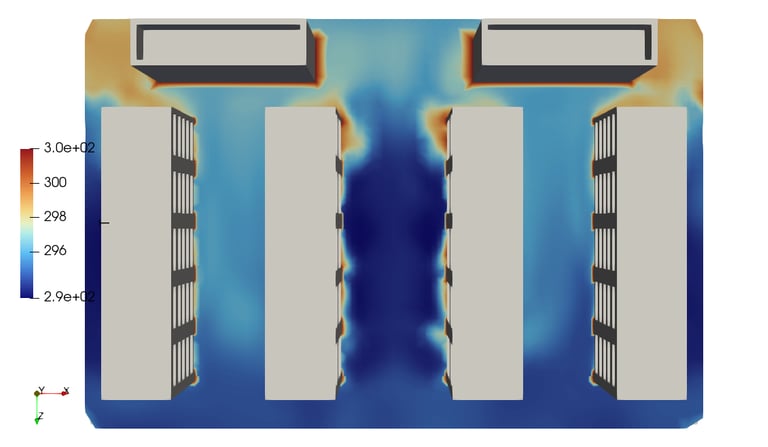
Key Concepts in ASHRAE 90.4
Standard 90.4 introduces two essential performance metrics that form the basis for compliance:
Mechanical Load Component (MLC):
The ratio of all mechanical power (for cooling, fans, pumps, and heat rejection equipment) to the total IT power of the data center.


Lower MLC values indicate more energy-efficient cooling systems.
Electrical Loss Component (ELC):
Represents the worst-case cumulative electrical losses across all segments of the power distribution chain, ensuring a minimum level of electrical efficiency.
Over time, ASHRAE has lowered the maximum allowable MLC and ELC values in successive editions to reflect the evolution of more efficient technologies and design techniques. These metrics incentivize designs that improve energy efficiency without compromising availability or reliability.
Additionally, Standard 90.4 rewards innovative strategies such as:
Heat recovery systems that reuse waste heat for adjacent facilities.
Shared-space economizers utilizing ambient air or water for cooling.
Collocation with non-data-center spaces that can benefit from heat generated by IT loads.
This integrated approach acknowledges that while data centers are mission-critical, they can also contribute to broader energy optimization within buildings or campuses.
How CFD Simulation Supports ASHRAE 90.4 Compliance
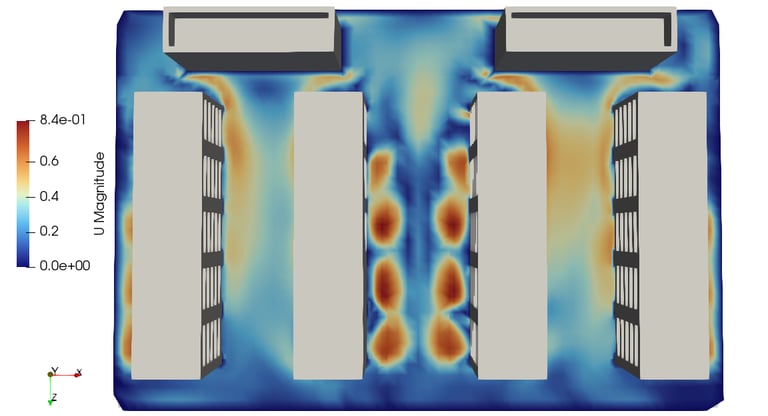
Designing an efficient cooling system involves balancing airflow, temperature distribution, and equipment layout — factors too complex for traditional analytical methods. Computational Fluid Dynamics (CFD) plays a vital role in visualizing and optimizing these parameters before implementation.
CFD simulation enables engineers to:
Visualize 3D airflow and temperature distribution throughout the data hall.
Evaluate pressure differentials and recirculation zones that affect cooling efficiency.
Compare containment strategies, equipment layouts, and HVAC configurations virtually.
Ensure ASHRAE 90.4 compliance by quantifying MLC-related energy loads and identifying design improvements.
By testing multiple scenarios virtually, CFD reduces trial-and-error costs and ensures that the final design achieves both performance and compliance targets.
Common Cooling Strategies in Data Centers
CRAC/CRAH Units (Air Conditioners and Air Handlers) – Deliver cold air to server racks and extract heat.
Hot Aisle/Cold Aisle Arrangement – Alternating airflow paths to manage temperature gradients.
Containment Systems – Isolate hot and cold aisles to prevent mixing and maintain consistent temperatures.
Liquid Cooling – Circulates chilled liquid near heat sources, ideal for high-density racks.
Free Cooling (Green Cooling) – Uses natural air or water for heat rejection to minimize mechanical energy use.
Each of these strategies affects the MLC differently. CFD simulations allow engineers to quantify these impacts and determine the most effective design combination for any given data center.
The Role of tensorHVAC-Pro
While conventional CFD tools are often complex and time-consuming, tensorHVAC-Pro offers a streamlined, engineer-friendly platform specifically tailored for HVAC and data center applications.
With tensorHVAC-Pro, users can:
Simulate airflow, heat transfer, and temperature gradients in data centers
Quantify energy performance metrics like MLC and ELC
Detect inefficiencies such as hot spots and recirculation zones
Validate compliance with ASHRAE 90.4 and related standards
Compare different cooling configurations quickly and visually
By integrating CFD analysis into early design stages, tensorHVAC-Pro empowers engineers to make data-driven design decisions that reduce operational costs and enhance energy efficiency — without requiring deep CFD expertise.
Conclusion
As global data demand grows, energy-efficient data center operation is no longer optional — it’s an engineering necessity. ASHRAE Standard 90.4 provides a structured framework for achieving this, defining measurable performance criteria that promote smarter, cleaner, and more reliable designs.
Combined with CFD simulation tools like tensorHVAC-Pro, engineers can visualize complex cooling dynamics, optimize performance, and ensure compliance with evolving industry standards.
By transforming simulation into a standard design practice, tensorHVAC-Pro helps build the next generation of sustainable data centers — where reliability, efficiency, and environmental responsibility coexist seamlessly.
tensorHVAC-Pro is a dedicated HVAC flow and thermal simulation software, Intuitive and easy to use, designed for HVAC engineers - not CFD expert. Learn more..
Download pdf Version
Read more articles..