The Secret to Better Ventilation Design? Seeing the Invisible.
When ventilation works well, nobody notices. The air feels fresh, comfortable, and quiet. But when it doesn’t, people feel it immediately — drafts, stuffy zones, or poor air quality. The challenge is that airflow is invisible, making it hard to understand and predict with traditional design methods.
ARTICLES
Wiratama
10/14/20252 min read
Air Is Invisible — But Its Effects Are Not
When ventilation works well, nobody notices. The air feels fresh, comfortable, and quiet. But when it doesn’t, people feel it immediately — drafts, stuffy zones, or poor air quality.
The challenge is that airflow is invisible, making it hard to understand and predict with traditional design methods.
That’s where TensorHVAC-Pro changes everything. It helps HVAC engineers see the invisible — transforming airflow into visual, measurable data that leads to smarter, cleaner, and more efficient ventilation systems.
1. Ventilation Isn’t Just About Ducts
Good ventilation is about more than supplying and returning air — it’s about how that air actually moves through the space.
Traditional design calculations estimate airflow rates, but they can’t show how air mixes, how contaminants disperse, or whether fresh air reaches every corner of a room.
TensorHVAC-Pro brings this unseen process to life through CFD simulation.
It lets you visualize:
Air circulation and mixing
Stagnant or dead zones
Fresh-air delivery paths
Contaminant or particle movement
This insight makes ventilation design more scientific — and more reliable.
2. See Where Air Really Goes
In real buildings, air takes the path of least resistance — not always the one engineers intend.
Obstacles like walls, beams, equipment, or furniture can distort flow patterns, creating poorly ventilated areas.
By running a TensorHVAC-Pro simulation, you can see how air moves around these obstacles and adjust diffuser placement, flow rates, or vent locations for optimal coverage.
The result? Even ventilation and healthier indoor air.
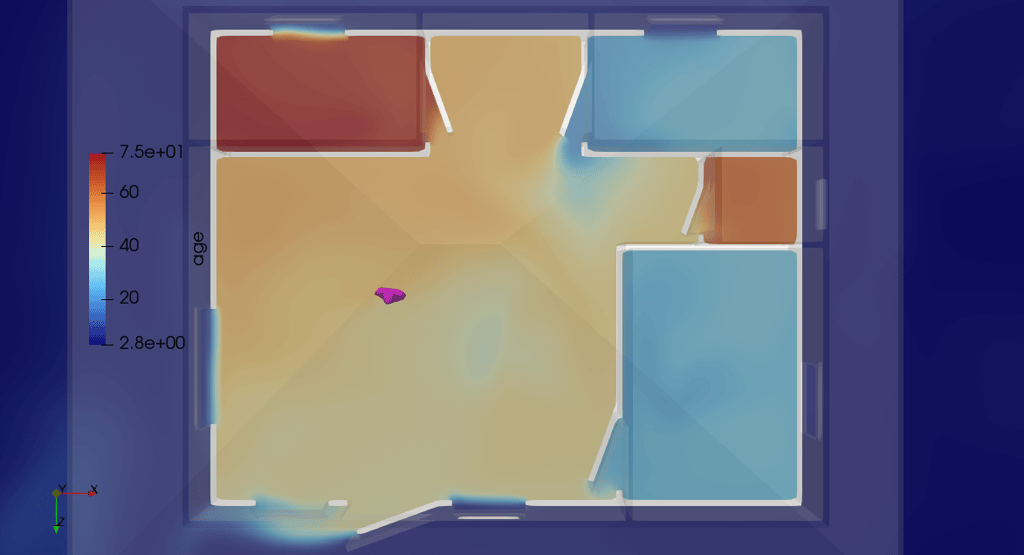
Figure below illustrated the "air age" distribution. We can see that some rooms are not well ventilated indicated by the red color
3. Design for Indoor Air Quality, Not Just Airflow
Ventilation is a key part of indoor air quality (IAQ). Poor airflow can allow CO₂, humidity, or airborne contaminants to build up in occupied zones.
Simulation with TensorHVAC-Pro allows you to track how air exchanges and pollutants move in real time — helping you meet or exceed ventilation standards while maintaining comfort.
4. Find and Fix Problems Before Installation
You can’t fix what you can’t see — until now.
With TensorHVAC-Pro, engineers can detect airflow issues long before construction begins, such as:
Short-circuiting between supply and return vents
Overventilated or underventilated zones
Air stratification near ceilings
Unwanted turbulence near occupants
These issues can be corrected digitally, saving thousands in field modifications and ensuring flawless system performance.
5. Balance Efficiency and Comfort
Better ventilation doesn’t have to mean higher energy bills.
Simulation helps you achieve both by revealing where air is wasted — allowing you to reduce fan power, optimize flow rates, and improve comfort simultaneously.
TensorHVAC-Pro makes it easy to test multiple scenarios and find the perfect balance between performance and efficiency.
6. Show Clients What They Can’t See
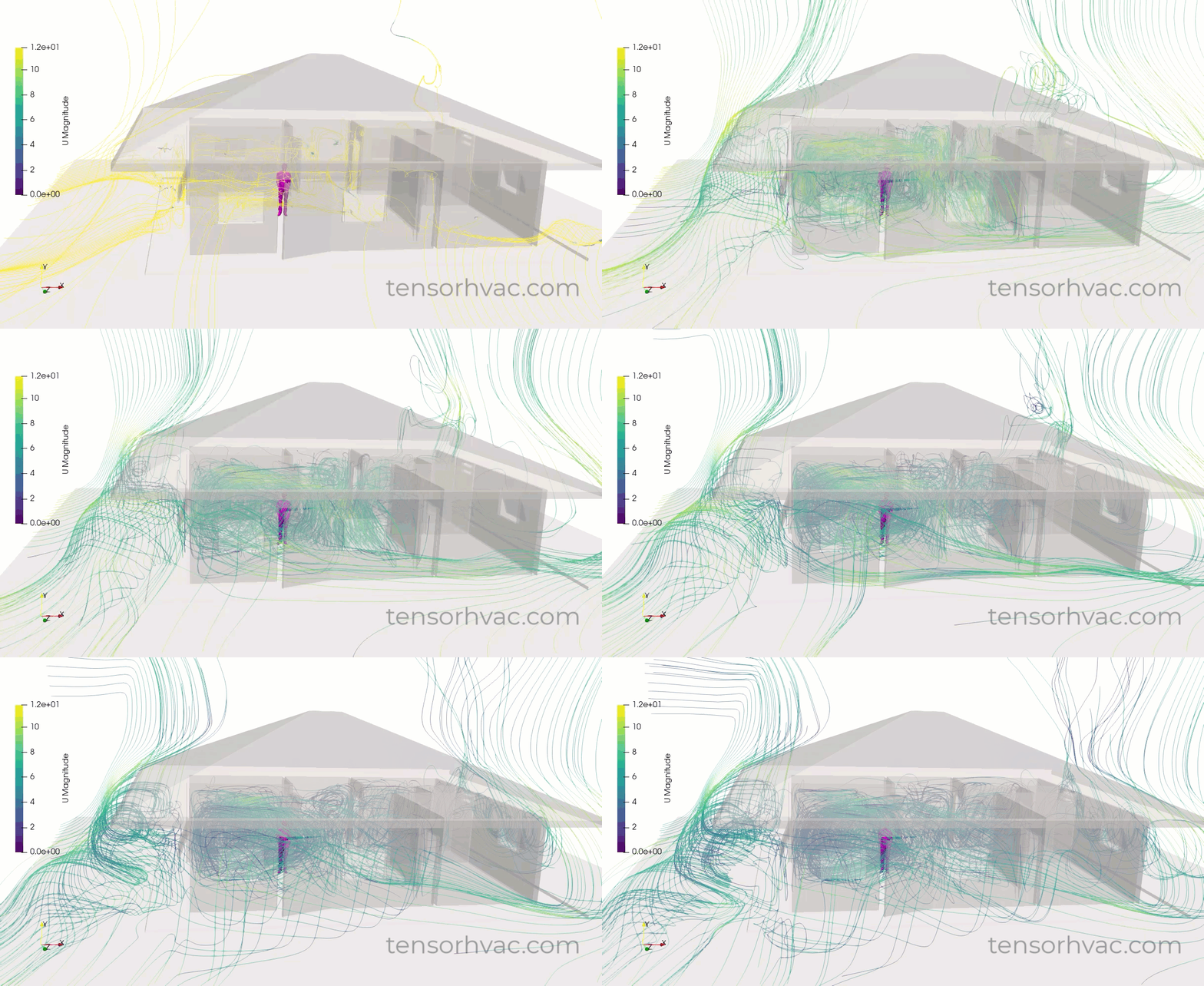
When you present airflow visualizations — colored streamlines, velocity maps, and temperature contours — clients instantly understand your design’s value.
It turns invisible engineering into clear visuals that inspire confidence.
You’re not just designing a ventilation system — you’re proving how it works.
See the Invisible. Design the Impossible.
Airflow may be invisible to the naked eye, but with TensorHVAC-Pro, it becomes crystal clear.
By visualizing ventilation before installation, you can optimize air quality, energy efficiency, and occupant comfort — while avoiding costly rework.
✅ See airflow. Understand comfort. Design better ventilation.
That’s the secret to smarter HVAC design — powered by TensorHVAC-Pro.