
The Simple Science Behind a Comfortable Indoor Environment
-
ARTICLES
Wiratama
10/14/20252 min read

Comfort Is More Than Just Cooling
When people think of HVAC, they think of temperature control. But thermal comfort isn’t just about how cool or warm the air is—it’s about how evenly that air moves, mixes, and interacts with occupants.
A truly comfortable indoor environment depends on the delicate balance between temperature, humidity, air velocity, and air distribution.
With TensorHVAC-Pro, engineers can understand and optimize that balance before a single duct is installed.
1. The Science of Air Movement
Air doesn’t move in straight lines—it swirls, diffuses, and circulates. Poorly designed diffusers or duct layouts can cause dead zones, drafts, or uneven temperatures.
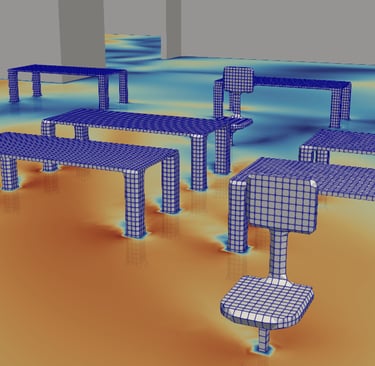
CFD simulation (Computational Fluid Dynamics) lets engineers visualize airflow patterns and velocity fields. You can clearly see where air might stagnate or where jets of cold air could cause discomfort.
With TensorHVAC-Pro, this analysis becomes fast, visual, and intuitive—turning invisible air into actionable design data.
2. Temperature Uniformity: The Heart of Comfort
Even if an HVAC system delivers the right cooling capacity, localized temperature differences can still make occupants uncomfortable.
Simulations show temperature gradients across a room, highlighting hot or cold spots. Engineers can then reposition supply vents, adjust airflow rates, or tweak diffuser types to achieve uniform conditions.
This scientific insight transforms trial-and-error design into precision engineering.
3. Humidity and Air Quality
Comfort also depends on humidity and air purity. Too dry, and occupants experience irritation; too humid, and condensation or mold can appear.
By combining CFD analysis with psychrometric insights, TensorHVAC-Pro helps predict how humidity and temperature interact inside a space. You can simulate fresh-air mixing and pollutant dispersion to ensure a clean, healthy atmosphere.
4. The Role of Air Velocity
Too slow—and air feels stuffy. Too fast—and it feels drafty.
The ideal air velocity typically lies between 0.15 and 0.25 m/s for comfort zones. TensorHVAC-Pro visualizes these velocities in 3D, helping you fine-tune diffuser angles and fan speeds for balanced comfort and quiet operation.
5. Why Simulation Makes It Simple
You don’t need to be a CFD expert to understand the science behind comfort. TensorHVAC-Pro brings advanced physics into an easy-to-use, visual platform designed specifically for HVAC professionals.
It helps you predict, test, and optimize air behavior—so your designs deliver consistent comfort with minimal energy use.
Comfort, Proven by Physics
The best HVAC systems are the ones you never notice—they simply work. Behind that effortless comfort is a solid foundation of airflow science.
With TensorHVAC-Pro, you can design systems that feel as good as they perform—scientifically optimized, energy-efficient, and built right the first time.
✅ Understand the science. Design with precision. Deliver comfort.
That’s the power of TensorHVAC-Pro.