
What is Boundary Conditions and Initial Conditions in CFD
In CFD, boundary conditions specify how the fluid behaves at the domain’s edges (e.g., inlet velocity, wall no-slip), while initial conditions define the fluid’s starting state (e.g., initial pressure, temperature, velocity) before the simulation begins.
THEORY-GUIDE
Wiratama
10/13/20252 min read
Boundary Conditions and Initial Conditions in CFD
In Computational Fluid Dynamics (CFD), the equations of fluid motion must be supplied with additional information before they can be solved. This information comes in the form of boundary conditions and initial conditions, which define how the fluid behaves at the domain limits and at the start of the simulation. Correctly specifying these conditions is essential for producing accurate and physically meaningful results.
1. What Are Boundary Conditions?
Boundary conditions describe the physical behavior of the fluid at the surfaces or limits of the computational domain. They tell the solver what happens at walls, inlets, outlets, openings, and interfaces.
Every CFD simulation requires boundary conditions for key variables such as velocity, pressure, temperature, turbulence, and thermal flux.
Common Types of Boundary Conditions
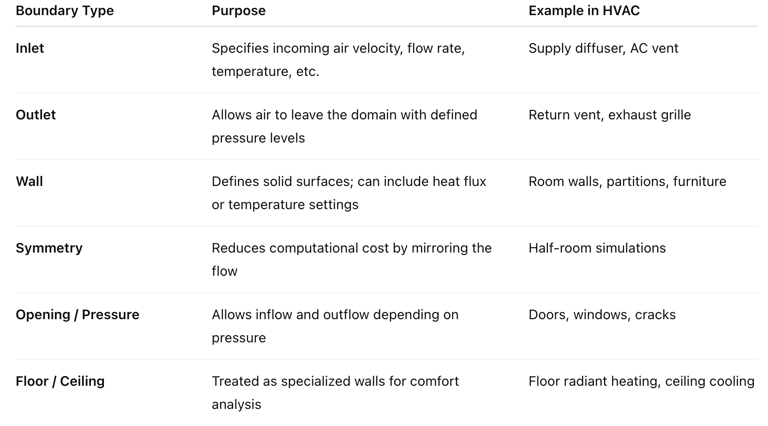
Boundary conditions enforce the physical constraints of the system. For example:
Walls enforce no-slip (zero velocity).
Inlets enforce fresh air supply.
Outlets enforce pressure reference conditions.
Heat sources enforce temperature or heat flux.
In tensorHVAC-Pro, boundary names such as inlet_1, outlet, wall_1, ceiling, and floor ensure the solver automatically assigns the correct boundary types.
2. What Are Initial Conditions?
Initial conditions specify the state of the fluid at the very beginning of the simulation. They define the starting values of key fields:
Velocity
Pressure
Temperature
Turbulence quantities
Scalar fields (PMV, age of air, CO₂ concentration, etc.)
Why Initial Conditions Matter
Even in steady-state solvers (like buoyantSimpleFoam used in tensorHVAC-Pro), the solver iterates from the initial state towards a converged final solution.
Good initial conditions help to:
Speed up convergence
Prevent solver instability
Reduce numerical oscillations
Improve accuracy
Typical Initial Conditions
For HVAC applications, common choices include:
Zero velocity everywhere (air is initially still)
Uniform temperature (e.g., 25 °C)
Uniform pressure field
Small initial turbulence levels
tensorHVAC-Pro sets recommended defaults automatically so users do not need to manually tune initialization parameters.
Boundary vs. Initial Conditions: Simple Summary
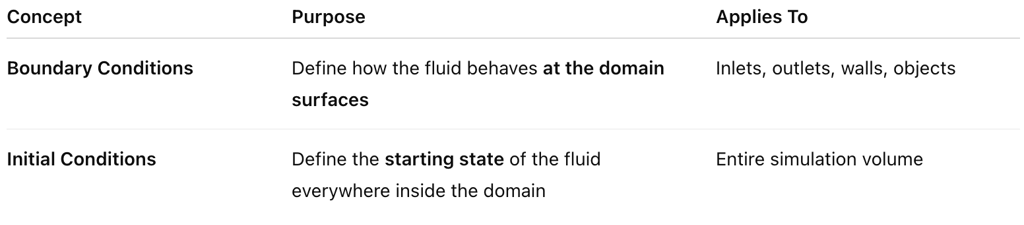
In tensorHVAC-Pro
tensorHVAC-Pro automates the selection of both:
Boundary conditions are set based on STL names (inlet_1, wall_1, object_1, etc.).
Initial conditions are assigned internally using stable defaults optimized for room airflow and comfort modeling.
This automation significantly simplifies the setup while maintaining the physical accuracy needed for HVAC simulations.