
What is Computational Fluid Dynamics
Discuss what is Computational Fluid Dynamics (CFD), from its numerical method, geometry preparation, meshing, running, and post-processing
THEORY-GUIDE
Wiratama
10/13/20252 min read
1. What is Computational Fluid Dynamics (CFD)?
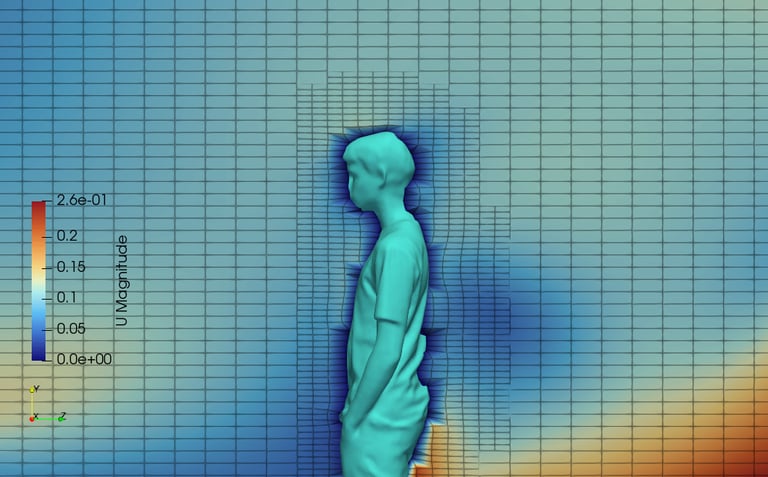
Computational Fluid Dynamics (CFD) is a numerical method used to analyze and predict fluid flow, heat transfer, and related physical phenomena. Instead of relying solely on experiments or simplified hand calculations, CFD solves the governing equations of fluid motion—known as the Navier–Stokes equations—inside a digital model of the system.
By dividing the domain into a mesh of small cells and applying physical laws to each cell, CFD computes detailed distributions of velocity, pressure, temperature, turbulence, buoyancy, and other relevant quantities. This makes CFD especially valuable in HVAC engineering, where airflow behavior, thermal comfort, ventilation effectiveness, and energy performance depend on complex interactions between heat sources, diffusers, occupants, and room geometry.
In tensorHVAC-Pro, CFD serves as the core engine that transforms room geometry, HVAC boundary conditions, and thermal loads into realistic predictions of indoor environmental quality.
2. What is OpenFOAM?
OpenFOAM is a widely used, open-source CFD software framework relied upon by researchers and industries around the world. It provides a comprehensive suite of solvers for modeling fluid flow, heat transfer, turbulence, multiphase systems, chemical reactions, and more.
Key characteristics of OpenFOAM include:
Open-source flexibility – Users can access, modify, and extend the simulation code.
Robust physics models – Including turbulence modeling, buoyancy, compressibility, and radiation.
High scalability – Capable of running from small engineering models to large HPC simulations.
Customizable workflows – Allowing developers to design specialized solvers for specific applications.
tensorHVAC-Pro is built on top of OpenFOAM, leveraging its stability and physical accuracy while providing an easier, more streamlined interface tailored to HVAC simulation. Users benefit from the power of OpenFOAM without needing to manage complex command-line operations, dictionaries, or coding.
3. What is the buoyantSimpleFoam Solver?
buoyantSimpleFoam is one of OpenFOAM’s primary solvers for HVAC-related simulations. It is a steady-state, buoyant, pressure-based solver for incompressible or mildly compressible flows with heat transfer. This makes it ideal for analyzing indoor airflow and temperature distribution where thermal effects and density differences drive the motion of air.
Key Features of buoyantSimpleFoam
Steady-state solution for faster convergence.
Models natural convection, forced convection, or a mix of both.
Includes buoyancy effects, enabling simulations where warm air rises and cool air sinks.
Supports turbulence models used in HVAC studies (e.g., k–ε, k–ω SST).
Solves for temperature, pressure, velocity, and turbulent quantities simultaneously.
Why buoyantSimpleFoam is suitable for HVAC
Most indoor environments rely heavily on buoyancy-driven flow—warm air from equipment rises, cold supply air falls, and stratification layers form. The solver captures:
Vertical temperature gradients
Draft formation
Thermal plumes from people or equipment
Interaction between mechanical ventilation and natural convection
tensorHVAC-Pro adapts and automates the buoyantSimpleFoam workflow, enabling engineers to run complex HVAC comfort simulations without manually configuring solvers, turbulence models, or thermophysical files.