
What is Mean Radiant Temperature and Operative Temperature
What is Mean Radiant Temperature and Operative Temperature
ARTICLES
Wiratama
12/20/20253 min read
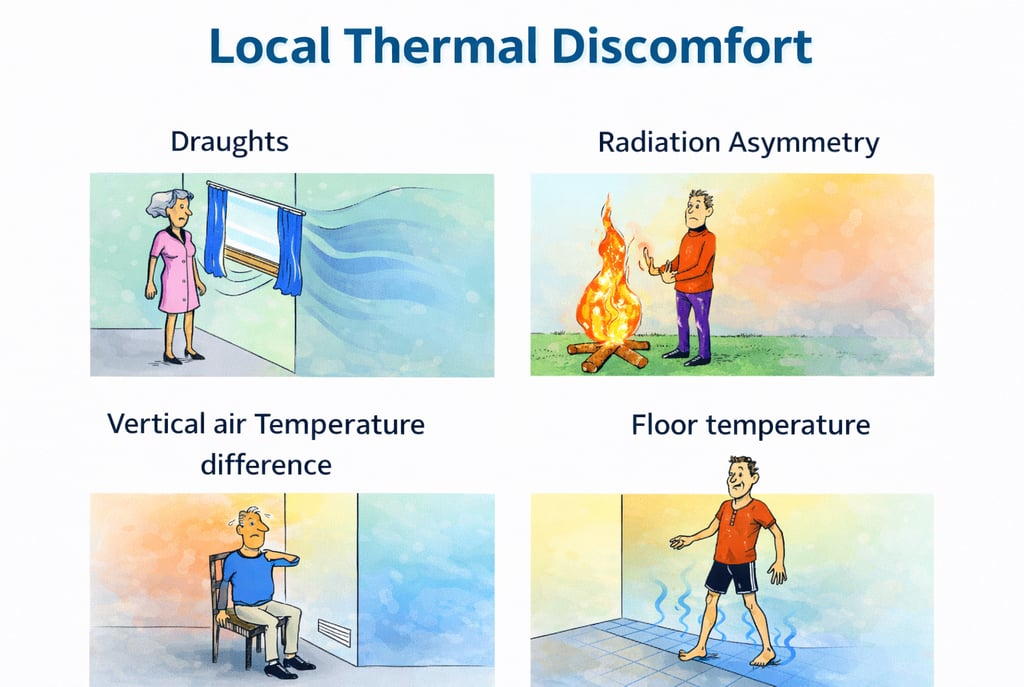
What Is Mean Radiant Temperature and Operative Temperature?
Thermal comfort is not determined by air temperature alone. In indoor environments, people exchange heat with their surroundings through convection, radiation, evaporation, and conduction. Among these mechanisms, radiative heat transfer plays a critical role, which is why concepts such as Mean Radiant Temperature (MRT) and Operative Temperature are fundamental in thermal comfort analysis and HVAC design.
Mean Radiant Temperature (MRT)
Mean Radiant Temperature is a measure of the average temperature of all surrounding surfaces, weighted by how much radiant heat they exchange with the human body. These surfaces include walls, ceilings, floors, windows, furniture, and any large objects within the space. MRT represents the uniform temperature of an imaginary enclosure in which the radiant heat exchange between the human body and the environment would be the same as in the actual space.
MRT becomes especially important when surface temperatures differ significantly from the air temperature. For example, sitting near a cold window in winter or a sunlit wall in summer can strongly affect comfort, even if the room’s air temperature remains unchanged. In such cases, the body gains or loses heat primarily through radiation rather than convection, leading to sensations of discomfort that cannot be explained by air temperature alone.
From a comfort perspective, high MRT increases the radiant heat load on the body and can cause overheating, while low MRT increases radiant heat loss and can make occupants feel cold. This is why MRT is particularly relevant in spaces with large glazing areas, radiant heating or cooling systems, and environments exposed to direct solar radiation.
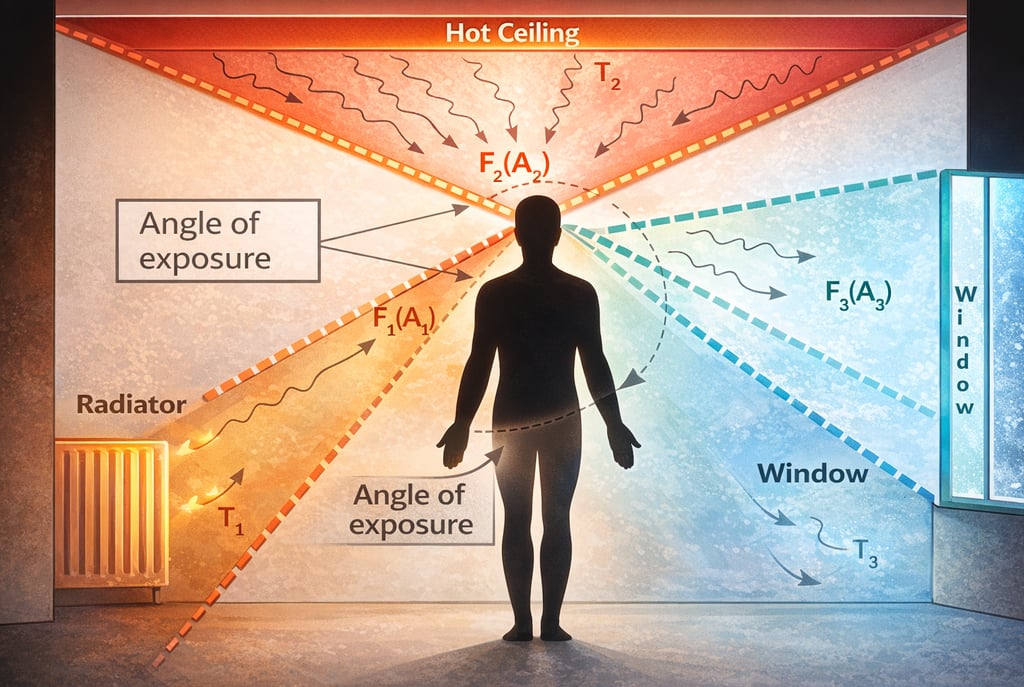
Operative Temperature
Operative temperature is a combined index that accounts for both air temperature and mean radiant temperature. It represents the uniform temperature of an imaginary environment that would cause the same heat exchange between the human body and the surroundings as the real environment.
In practical terms, operative temperature reflects what people actually feel, rather than what a thermometer measuring air temperature alone would indicate. When air movement is low, operative temperature is approximately the average of air temperature and MRT. As air velocity increases, convection becomes more dominant, and air temperature has a greater influence on operative temperature.
Because it integrates the effects of convection and radiation, operative temperature is widely used in thermal comfort standards, building design, and HVAC performance evaluation. It provides a more realistic assessment of comfort conditions than air temperature alone, especially in spaces where surface temperatures vary.
Relationship to Human Comfort
The human body continuously exchanges heat with both the surrounding air and nearby surfaces. If air temperature is comfortable but MRT is high due to warm walls or solar radiation, occupants may still feel too warm. Conversely, a cool MRT caused by cold surfaces can result in discomfort even when air temperature is relatively high.
Operative temperature captures this interaction and explains why two rooms with the same air temperature can feel very different. A room with warm surfaces and moderate air temperature can feel more comfortable than one with cold surfaces and the same air temperature. This explains common experiences such as feeling cold near a window in winter or feeling overheated near sunlit walls.
Importance in HVAC and Building Design
Modern HVAC systems and comfort standards rely heavily on MRT and operative temperature to ensure occupant comfort. Radiant heating and cooling systems are designed specifically to control MRT rather than air temperature alone. Similarly, building envelope design, insulation, glazing selection, and shading strategies all influence MRT and, consequently, operative temperature.
In thermal comfort analysis, including CFD simulations and comfort modeling, MRT and operative temperature are essential parameters for predicting occupant satisfaction. They allow engineers to assess radiant asymmetry, surface temperature effects, and overall comfort more accurately than air temperature measurements alone.
Summary
Mean Radiant Temperature represents the influence of surrounding surface temperatures on the human body through radiation, while operative temperature combines the effects of air temperature and radiation into a single comfort metric. Together, they provide a comprehensive understanding of how indoor environments are perceived by occupants. Recognizing the importance of MRT and operative temperature is essential for designing buildings that are not only energy efficient but also truly comfortable for the people who occupy them.
Read more articles..