
What is Relative Humidity and How It Related to Comfort
What is Relative Humidity and How It Related to Comfort
THEORY-GUIDEARTICLES
Wiratama
12/20/20253 min read
What Is Relative Humidity and How Is It Related to Comfort?
Relative humidity (RH) is a key atmospheric parameter that strongly influences human comfort, indoor air quality, and overall environmental conditions. While air temperature is often considered the primary factor affecting how warm or cool a space feels, humidity plays an equally important role in determining whether an environment feels comfortable, dry, or oppressive.
Relative humidity is defined as the ratio between the actual amount of water vapor present in the air and the maximum amount of water vapor the air can hold at a specific temperature. This ratio is expressed as a percentage. When relative humidity reaches 100 %, the air is fully saturated and cannot hold additional moisture. At lower values, such as 50 %, the air contains only half of the moisture it could potentially hold at that temperature. Because warm air can retain more moisture than cold air, relative humidity is highly dependent on temperature and can change even if the absolute moisture content remains constant.
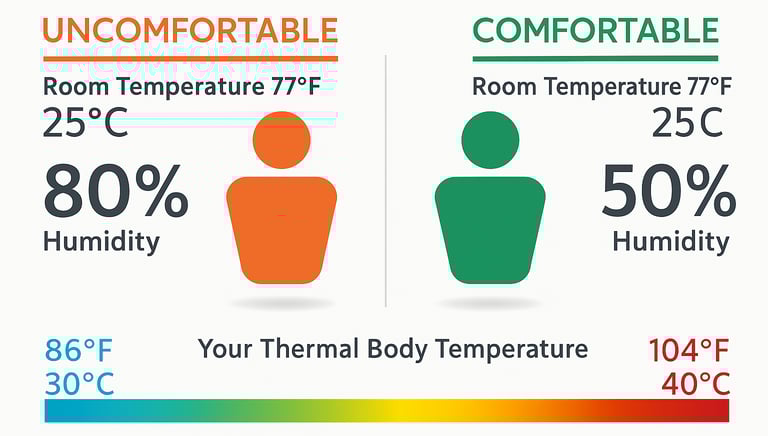
The importance of relative humidity for comfort lies in how the human body regulates heat. The body relies heavily on sweating and the evaporation of sweat from the skin to release excess heat. Relative humidity directly affects this evaporation process. When humidity levels are balanced, sweat evaporates at a comfortable rate, allowing the body to maintain a stable internal temperature without discomfort.
When relative humidity is too low, typically below about 30 %, moisture evaporates very quickly from the skin and mucous membranes. This can lead to dry skin, irritated eyes, sore throats, and discomfort in the respiratory system. Low humidity is common in air-conditioned spaces and in cold climates during winter, where heating systems significantly reduce indoor moisture levels.
On the other hand, high relative humidity, generally above 70 %, interferes with the evaporation of sweat. As a result, the body struggles to release heat efficiently, making the air feel much hotter than the actual measured temperature. This condition often causes sensations of stickiness, fatigue, and general discomfort. High humidity also creates favorable conditions for mold growth, unpleasant odors, and reduced indoor air quality, especially in poorly ventilated spaces.
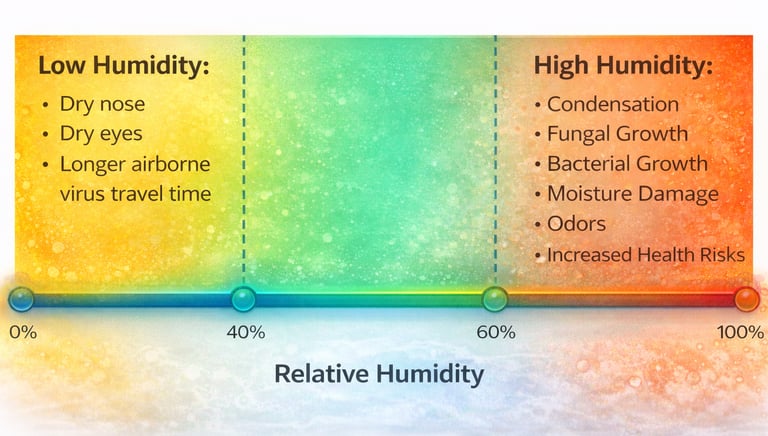
For most people, the optimal range of relative humidity for comfort is between 40 and 60 percent. Within this range, the balance between heat loss and moisture retention is ideal, resulting in a comfortable indoor environment. Skin feels neither too dry nor too clammy, breathing feels natural, and overall thermal comfort is significantly improved. This is why modern heating, ventilation, and air-conditioning systems are designed to regulate humidity in addition to temperature.
Relative humidity cannot be evaluated independently of temperature. For example, an air temperature of 30°C with high humidity feels far more uncomfortable than the same temperature with lower humidity. This combined effect is often described using the heat index, which represents how hot conditions feel to the human body. Engineers and HVAC professionals commonly use psychrometric charts to analyze these interactions, as they clearly show the relationships between temperature, humidity, and moisture content.
In building and HVAC design, controlling relative humidity is essential for both comfort and performance. Residential buildings, offices, hospitals, data centers, and industrial facilities all require proper humidity management. Inadequate control can lead to condensation, corrosion, material degradation, and reduced equipment lifespan, in addition to occupant discomfort. As a result, humidity control strategies such as humidification, dehumidification, and proper ventilation are critical components of well-designed indoor environments.
In summary, relative humidity plays a vital role in determining how comfortable an environment feels. Even when air temperature remains constant, changes in humidity can dramatically alter human perception of warmth and comfort. Maintaining relative humidity within the recommended range of 40 % to 60 % is essential not only for comfort but also for health, building durability, and efficient HVAC operation.
tensorHVAC-Pro is a dedicated HVAC flow and thermal simulation software, Intuitive and easy to use, designed for HVAC engineers - not CFD expert. Learn more..
Read more tensorHVAC-Pro Theory guides...