
What’s Really Happening When You Turn On the Air Conditioner
Understanding what really happens when you turn on the air conditioner helps HVAC engineers design systems that don’t just cool the air — they create comfort efficiently and evenly.
ARTICLES
Wiratama
10/14/20252 min read
The Invisible Science Behind Comfort
You walk into a room, press the power button, and within minutes the air feels cooler and more comfortable.
But behind that simple experience lies a complex chain of events — involving fluid dynamics, heat transfer, and air circulation.
Understanding what really happens when you turn on the air conditioner helps HVAC engineers design systems that don’t just cool the air — they create comfort efficiently and evenly.
1. Cooling Starts with Air Movement
When you turn on an air conditioner, the indoor unit begins pulling warm air from the room through a return vent.
That air passes over a cold evaporator coil, where the refrigerant absorbs heat energy. The air’s temperature drops, and it’s then pushed back into the room through supply diffusers.
This continuous loop — intake, cooling, and redistribution — is what maintains the desired indoor temperature.
But here’s the catch: air doesn’t spread evenly. It interacts with walls, furniture, ceilings, and people — leading to hot spots, drafts, or uneven cooling if the flow isn’t properly designed.
2. Temperature Isn’t Everything
Most people think comfort is just about air temperature.
In reality, air velocity, humidity, and mixing play equally important roles.
For example:
High velocity near a diffuser can make occupants feel uncomfortably cold.
Poor circulation can trap warm air in the corners or near ceilings.
Imbalanced humidity levels can cause discomfort even at the right temperature.
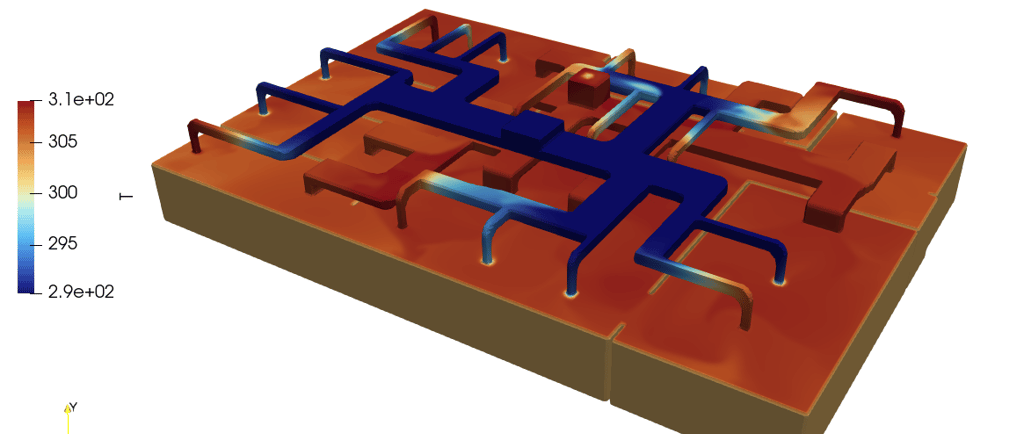
This is why CFD (Computational Fluid Dynamics) simulation in TensorHVAC-Pro matters — it lets engineers see and predict how cooled air behaves in real spaces before installation.
3. The Role of Pressure and Flow Balance
Every HVAC system depends on maintaining the right pressure balance between supply and return air.
If pressure is too high, it creates noise and energy waste.
If it’s too low, airflow becomes uneven and ventilation suffers.
Traditional design methods estimate these effects, but TensorHVAC-Pro actually simulates them — showing how pressure drops along ducts, bends, and fittings influence performance.
4. How the Room Reacts
Once cool air enters the space, it interacts with warmer surfaces — windows, walls, lighting, and even people. These objects radiate heat back into the air, causing natural convection currents.
This process is invisible but critical.
TensorHVAC-Pro allows engineers to visualize these thermal layers and recirculation zones, ensuring that cool air reaches where it’s needed most — not just where ducts happen to point.
5. Energy Efficiency in Motion
An efficient air conditioner doesn’t just cool — it balances comfort with minimal energy use.
By using virtual airflow testing, engineers can:
Optimize diffuser placement for uniform cooling.
Reduce fan power by minimizing unnecessary resistance.
Prevent overcooling certain zones, saving energy while maintaining comfort.
Simulation ensures that every cubic meter of air is doing useful work — not wasted in turbulence or dead zones.
6. Seeing the Invisible with TensorHVAC-Pro
What happens when you turn on an air conditioner is a perfect example of physics in action.
Air moves, mixes, and adapts dynamically to the environment. With TensorHVAC-Pro, HVAC engineers can visualize all of it — in color maps, velocity vectors, and temperature contours — before the system is ever built.
It turns invisible airflow into clear insight, helping designers make smarter, more efficient decisions.
From Cooling to Comfort
Air conditioning isn’t just about lowering temperature — it’s about controlling how air moves and feels.
By understanding and simulating what truly happens when an AC system runs, engineers can design spaces that are quiet, efficient, and perfectly comfortable from the very first switch-on.
✅ Visualize the unseen. Optimize performance. Deliver comfort.
That’s the science — and the power — behind TensorHVAC-Pro.