
Why Traditional HVAC Design Misses the Real Flow of Air
Most HVAC designs still start the same way — with steady-state calculations, duct sizing charts, and design experience. These methods have worked for decades, but they have one limitation: they simplify reality. Air doesn’t move in straight lines. It swirls, accelerates, slows, and mixes. It’s influenced by room geometry, obstacles, and even people. Traditional design can’t always predict this complex behavior — but simulation can.
ARTICLES
Wiratama
10/14/20252 min read
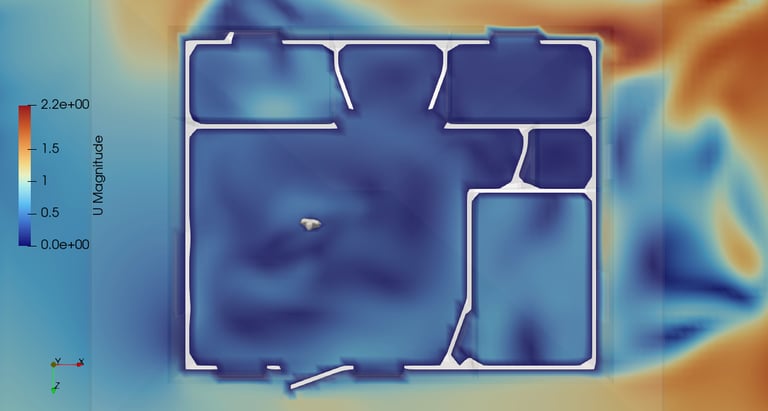

When Equations Aren’t Enough
Most HVAC designs still start the same way — with steady-state calculations, duct sizing charts, and design experience. These methods have worked for decades, but they have one limitation: they simplify reality.
Air doesn’t move in straight lines. It swirls, accelerates, slows, and mixes. It’s influenced by room geometry, obstacles, and even people. Traditional design can’t always predict this complex behavior — but simulation can.
1. Static Calculations vs. Dynamic Reality
Conventional HVAC design tools calculate airflow in simplified terms: uniform flow rates, steady temperatures, and average velocities.
In reality, airflow is three-dimensional and dynamic. Corners create recirculation zones, diffusers interact with walls, and return vents can pull conditioned air away from occupants.
TensorHVAC-Pro captures these real-world effects through CFD simulation, helping engineers see what equations can’t — the true path of air through a space.
2. The Hidden Problems Behind “Balanced” Systems
Even when airflow rates seem balanced on paper, problems can still arise:
Hot and cold spots due to poor air mixing
Drafts from high-velocity jets
Stagnant zones with poor ventilation
Unpredictable return flow behavior
Traditional design methods can’t visualize these issues. But with TensorHVAC-Pro, engineers can identify and fix them before construction — ensuring comfort, performance, and efficiency from the start.
3. Architectural Complexity Changes Everything
Modern buildings are no longer simple boxes. They include open atriums, high ceilings, glass façades, and complex geometries that affect how air moves.
In these environments, old design assumptions fall short.
CFD-based simulation through TensorHVAC-Pro lets you evaluate airflow behavior under real architectural conditions — accounting for shape, obstacles, and occupant distribution. It’s design validation for modern architecture.
4. Comfort Is a 3D Experience
Thermal comfort isn’t just about average temperature — it’s about how air feels throughout the space.
Traditional design checks might ensure a 24°C supply temperature, but they can’t tell if the person sitting near a vent feels a cold draft or if a corner stays stuffy.
TensorHVAC-Pro visualizes velocity and temperature distributions in 3D, helping engineers fine-tune diffuser placement and flow rates for true occupant comfort.
5. The Energy Efficiency Blind Spot
Without understanding the actual air path, systems are often overdesigned — using larger fans, higher flow rates, and more power than necessary.
Simulation identifies where energy is wasted and where flow can be optimized, enabling smaller, smarter, and more efficient systems.
TensorHVAC-Pro helps strike the balance between comfort and sustainability, reducing both energy use and operating costs.
6. Bringing Real Physics Into Everyday Design
The truth is, the “real flow of air” can’t be captured by manual methods alone.
That’s why top-performing HVAC engineers are moving toward virtual testing and simulation. TensorHVAC-Pro makes this transition practical — combining real fluid physics with an accessible, cost-efficient platform designed for everyday engineering use.
See the Flow. Fix the Flaws. Design It Right.
Traditional HVAC design methods provide estimates. Simulation provides understanding.
With TensorHVAC-Pro, you can visualize how air truly moves, interacts, and delivers comfort — before installation begins.
✅ Understand the flow. Design with confidence. Deliver comfort.
That’s the future of HVAC design — powered by TensorHVAC-Pro.