
How ASHRAE 55 standard define comfort
ASHRAE 55 defines comfort as a condition where most people feel thermally satisfied — typically when PMV is between -0.5 and +0.5 and PPD is below 20%
ARTICLES
Wiratama
10/29/20254 min read
What Is ASHRAE 55?
Understanding Thermal Comfort Standard
As energy efficiency and occupant well-being become key priorities in modern building design, thermal comfort is now one of the most critical factors in HVAC engineering. The ASHRAE Standard 55, developed by the American Society of Heating, Refrigerating, and Air-Conditioning Engineers, defines the conditions that produce thermal environments acceptable to most occupants. It provides a scientific basis for designing HVAC systems that balance temperature, humidity, air movement, and radiant heat — ensuring spaces are both comfortable and efficient.
With the help of advanced simulation tools like tensorHVAC-Pro, HVAC engineers can now visualize, predict, and optimize thermal comfort conditions long before a system is built.
The Purpose of ASHRAE 55
ASHRAE 55 defines thermal comfort as “that condition of mind which expresses satisfaction with the thermal environment.” In simpler terms, it describes how people feel — too warm, too cold, or just right.
The standard outlines the combinations of environmental and personal factors that influence comfort:
Air temperature
Humidity
Mean radiant temperature
Air velocity
Metabolic rate (1 met = 60 W/m2)
Clothing insulation (clo value)
To comply with ASHRAE 55, all these factors must be considered together. Using simulation-based analysis, engineers can test thousands of comfort scenarios to ensure that at least 80% of occupants fall within the optimal comfort zone.
A Brief History of ASHRAE 55
Since its first publication in 1966, ASHRAE 55 has evolved to reflect advances in building science and human comfort research.
2004 Update: Introduced computer-based modeling and the adaptive comfort model, relating indoor comfort to outdoor weather for naturally ventilated buildings.
2010 Update: Reintroduced the Standard Effective Temperature (SET) and emphasized documentation for compliance.
2017 Update: Expanded the model to include the impact of direct solar radiation on occupant comfort.
Today, ASHRAE 55 is recognized globally as the benchmark for thermal comfort compliance — integrated into most building energy and design codes.
Environmental and Personal Factors in Comfort Design
Thermal comfort depends on both the environment and the individual.
Environmental Factors
Air temperature: The most direct measure of comfort but not the only one.
Airspeed: Influences convective cooling and perceived freshness of air.
Humidity: Affects the body’s ability to dissipate heat through sweat.
Mean radiant temperature: Represents the effect of heat exchange between the body and surrounding surfaces.
Personal Factors
Metabolic rate (met): Learn the detail here >>
Clothing insulation (clo): Learn the detail here >>
PMV and PPD: The Core of ASHRAE 55 Analysis
Two main indices are used to evaluate thermal comfort under ASHRAE 55:
PMV (Predicted Mean Vote): Predicts the average thermal sensation of occupants on a 7-point scale from -3 (cold) to +3 (hot). A PMV close to 0 indicates thermal neutrality.
PPD (Predicted Percentage Dissatisfied): Estimates what percentage of people are likely to feel uncomfortable at a given PMV level.
For optimal conditions, ASHRAE 55 defines a comfort range between -0.5 and +0.5 PMV, corresponding to PPD ≤ 10–20%.
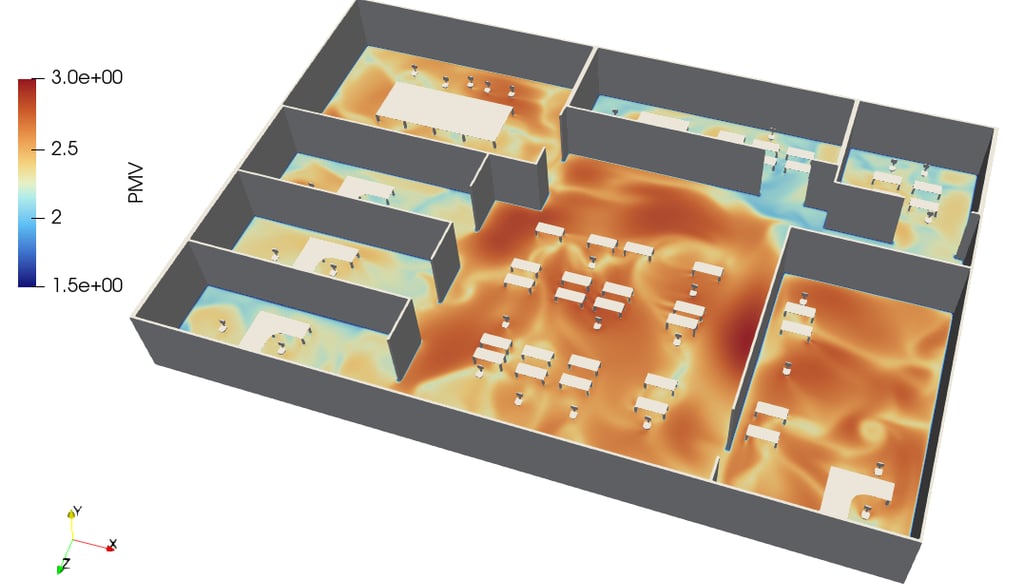
With tensorHVAC-Pro, HVAC engineers can simulate PMV and PPD fields directly from airflow and temperature results — visualizing comfort zones as color maps and adjusting system parameters to bring all areas within the comfort threshold.
Achieving ASHRAE 55 Compliance with CFD Simulation
Compliance with ASHRAE 55 involves more than temperature control — it requires maintaining steady-state comfort across all zones. CFD (Computational Fluid Dynamics) simulation provides the most accurate way to analyze how air distribution, heat sources, and boundary conditions interact within a room.
Using tensorHVAC-Pro, engineers can:
Predict PMV and PPD distribution across spaces.
Visualize air velocity, temperature, and mean radiant temperature.
Evaluate local discomfort, such as drafts or vertical temperature gradients.
Validate HVAC design against ASHRAE 55 thermal comfort zones.
Unlike traditional CFD tools, tensorHVAC-Pro is built specifically for HVAC engineers, not CFD experts — offering automated meshing, solver settings, and ready-to-use comfort models aligned with ASHRAE standards.
Example: Office Thermal Comfort Evaluation
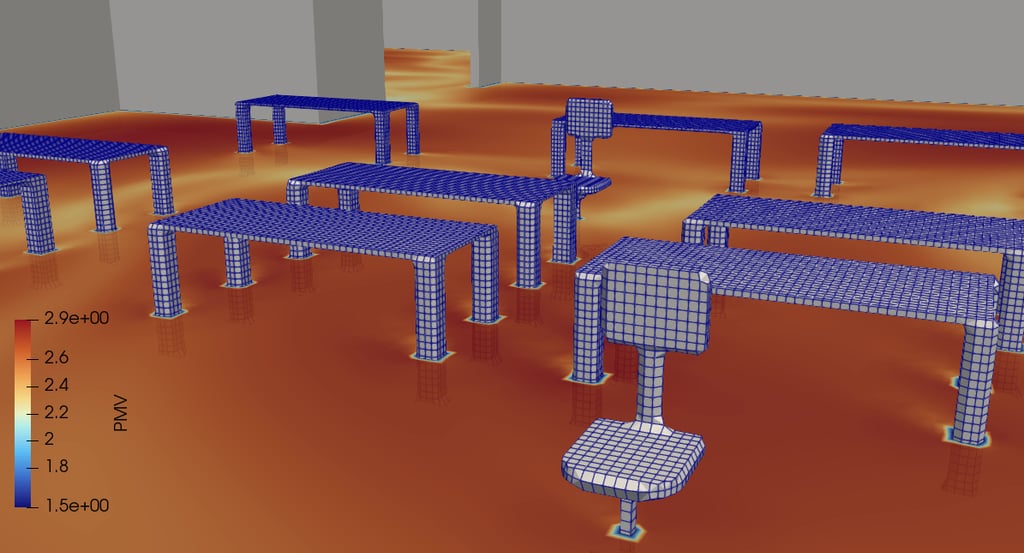
Consider an open-plan office with multiple diffusers and varying heat loads from equipment. With tensorHVAC-Pro, an engineer can simulate airflow and thermal patterns in 3D, then generate PMV and PPD contour plots.
The simulation reveals that certain corners experience elevated PMV values due to insufficient airflow. By adjusting diffuser direction and supply air temperature, the engineer reduces PPD below 15% — achieving ASHRAE 55 compliance and improving occupant comfort.
How tensorHVAC-Pro Simplifies Thermal Comfort Analysis
Traditional CFD workflows require advanced setup and computation expertise. tensorHVAC-Pro eliminates that complexity with a purpose-built HVAC simulation environment.
Key features include:
Automated comfort parameter calculation (PMV, PPD, DR)
Predefined boundary condition templates for diffusers, occupants, and heat sources
3D visualization tools for temperature, airspeed, and comfort zones
ASHRAE-based comfort analysis modules for quick validation
By simulating airflow and thermal behavior early in the design phase, engineers can ensure energy-efficient and comfortable HVAC systems — without repetitive field testing or trial-and-error.
Conclusion
The ASHRAE 55 standard defines what it means to create thermally comfortable spaces — a balance of air, temperature, and human perception. Ensuring compliance requires more than traditional design methods; it requires insight into how the indoor environment behaves.
With tensorHVAC-Pro, HVAC engineers gain the ability to perform ASHRAE 55–based CFD simulations quickly and intuitively. From predicting comfort zones to optimizing air distribution, tensorHVAC-Pro bridges the gap between CFD precision and HVAC practicality — empowering engineers to design spaces where people truly feel comfortable.

Download pdf of this article
tensorHVAC-Pro is a dedicated HVAC flow and thermal simulation software, intuitive and easy to use, designed for HVAC engineers - not CFD expert. Learn more..
Read more articles..